The problem
Every AI tool does everything on the landing page.
Summaries, drafts, search, a chat box, an API. Forty tools, one feature list. So the decision gets made on the demo, the price in the left-hand column, and whoever in the room has the strongest opinion. Then the differences show up. They always show up in the same three places, and none of them is on the feature page.
All three are predictable in week one. You just have to ask in an order that stops the shiny one from winning.
The outcome
What you walk out with
- A shape. One page that fixes what you need before anyone opens a pricing tab. The one job, the seats in twelve months, the ceiling, who signs.
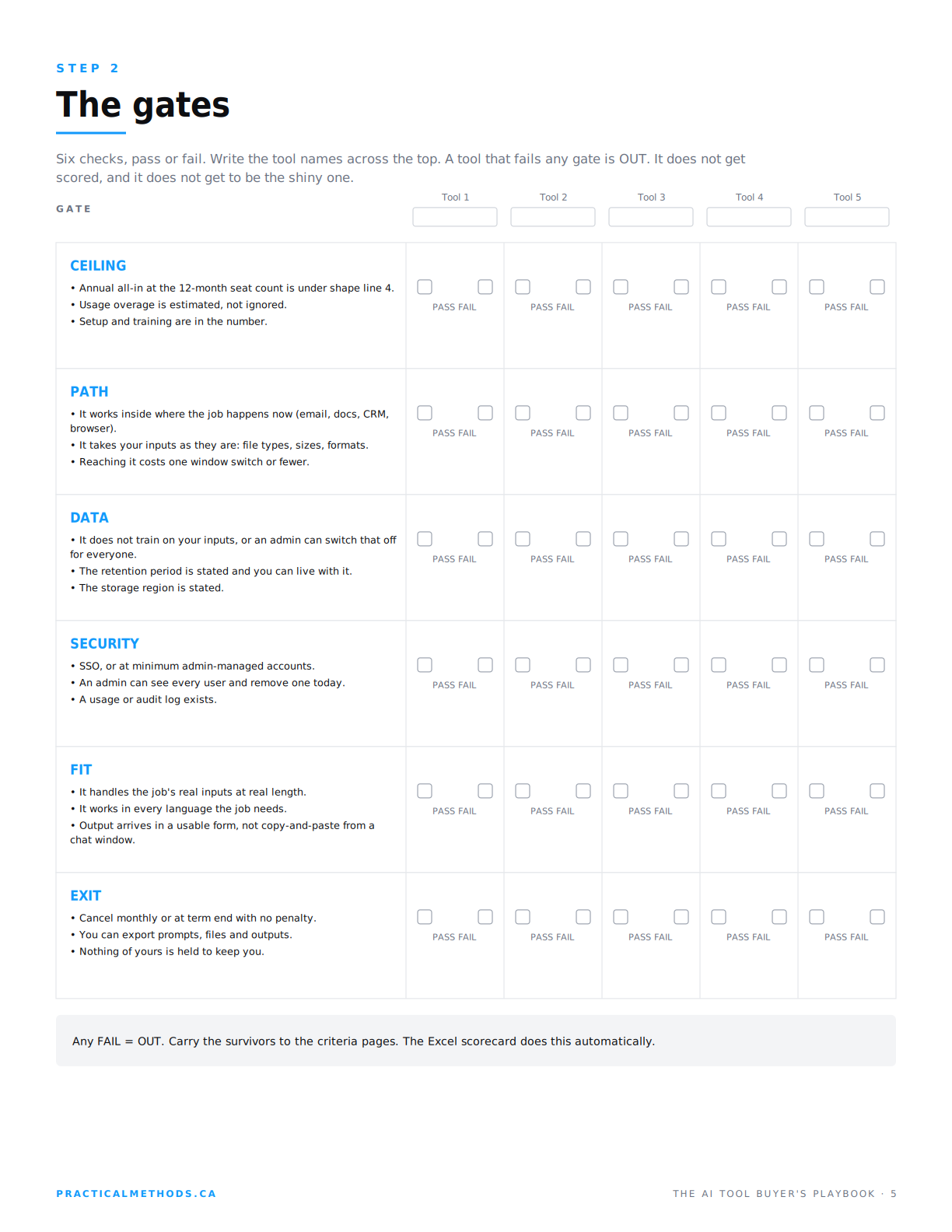
- A shortlist that earned it. Up to five tools that passed six pass-or-fail gates: ceiling, path, data, security, fit, exit. Anything that failed is out, no matter how good the demo was.
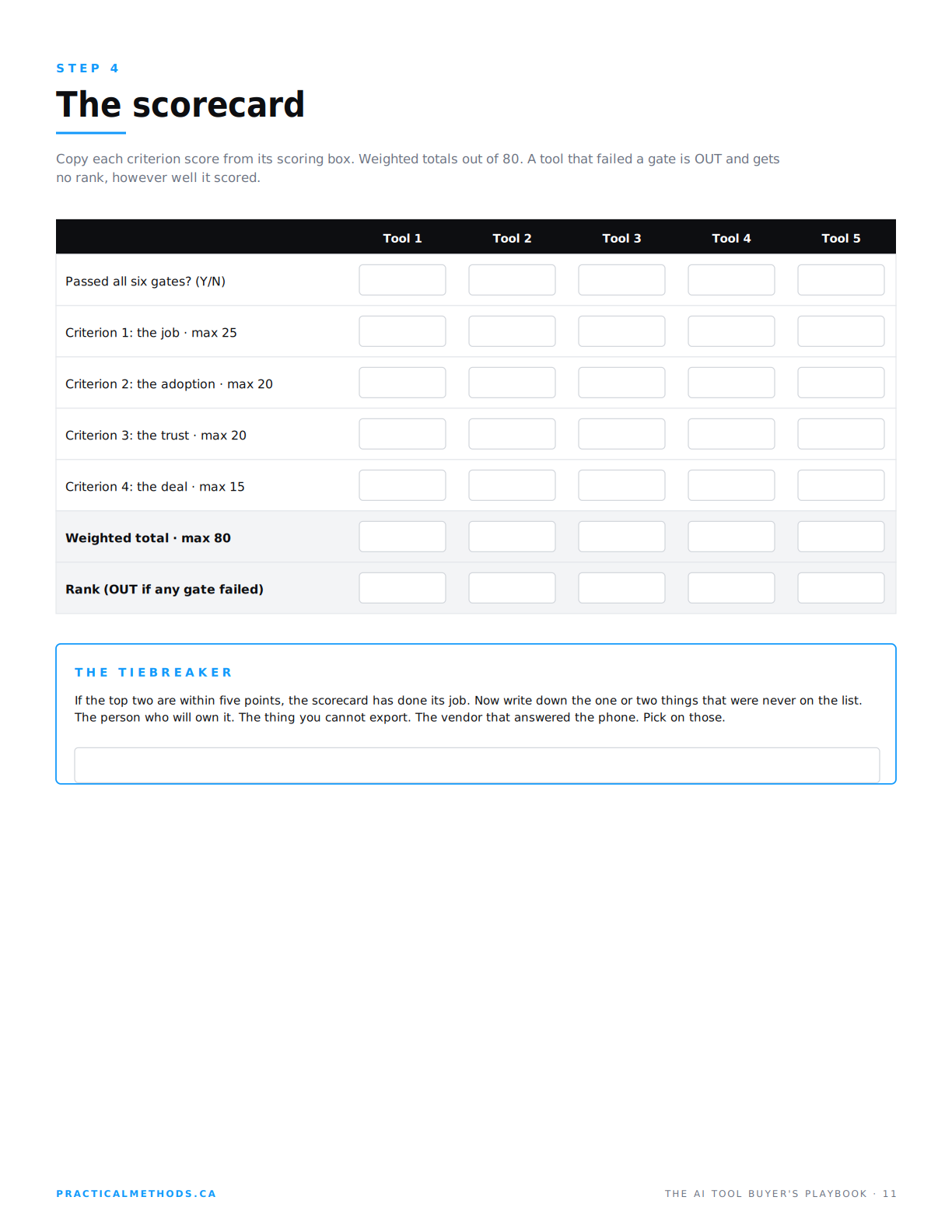
- A score you can defend. Four weighted criteria, 46 questions, rated on the trial with your real data. The weights are yours to change, and the scorecard recalculates when you do.
- The two questions that decided it. Not forty. The one or two that actually moved the score. That is the decision. The list was how you found it.
- A terms page, ready for the quote. Tier, seats, usage cap, renewal cap, notice window, data deletion, cancellation. Filled in from the written quote, not the pricing page. Sign against that.
- A 90-day review, booked. Five questions that tell you which score was wrong, before the renewal does.
The AI Tool Buyer's Playbook
The workbook, the Excel scorecard, the session deck and the facilitator's guide. Run it with your team in ninety minutes.
Get the Playbook · $49The method
How it works
Write the shape. Run gate 0, the bundled test, which will tell you if the assistant you already pay for does the job. Pick the rung: bundled, a general seat, a point tool, or a build. Then the six gates.
The job (weight 5). The adoption (4). The trust (4). The deal (3). 46 questions, rated on the trial. The Excel scorecard does the arithmetic. The weights are editable.
The tiebreaker is not the score. It is the one or two things that were never on the list. Write them down. That is the decision.
What is inside
Four files, one download
12 pages, printable. Rating circles for five tools, the gates table, the scorecard, the terms page.
Eight tabs. Type the tool names once, rate every question, and the weighted totals, OUT verdicts and rank calculate. Weights are editable.
Fifteen slides that run the method with the team in the room in ninety minutes.
The run sheet, the prework, and what to do when the session turns into a demo.
The questions
The questions almost nobody asks
- What is the plan for the person who refuses to use it?
- Who is the vendor's actual customer: you, or your data?
- What does the bundled tool cost for the same job? Zero is a real number.
- If this tool vanished in six months, what would you have lost?
FAQ
Frequently asked questions
What do I get?
Four files in one download: a 12-page printable workbook (PDF), an Excel scorecard with the arithmetic done, a 15-slide group session deck, and a facilitator's guide for running the ninety-minute session.
Does it tell me which AI tool to buy?
No. It is a method. It gets you from hundreds of tools to one decision your team will still agree with in ninety days. Not a review, not rankings, not software advice.
Who is it for?
Firms of five to fifty people choosing a tool for one job. The owner, the person who will own the tool, and the people who do the job.
Does it work if we already pay for Microsoft 365 or Google Workspace?
It starts there. Gate 0 is the bundled test, which asks whether the assistant you already pay for does the job before you shop for another.
What if I disagree with the weights?
Change them. The weight cells in the Excel scorecard are editable and every total recalculates. The order of the method does not change.
Can I run this without the session?
Yes. The workbook and scorecard work alone. The deck and guide are for when the decision needs a room.
The list is not the decision. It is how you find the one or two things that are.
Not a review, not rankings, not software advice. A method. Read the series first: Criteria: Buying an AI Tool.

