
Buying a CRM
CRM pricing for a six-person team: what year one actually costs
Quick answer: For a six-person team that needs email sync, year one in US dollars on annual billing runs roughly $1,000 to $2,800 on the entry tier that actually has the feature: Zoho Professional about $1,660, Pipedrive Growth about $2,810, HubSpot Sales Starter about $1,080 to $1,440 depending on the promotion, monday CRM Basic about $860. The trap is not the price. It is the tier: the plan you remember is one column left of the one with the feature you need, and the number shown is monthly, billed annually, in advance. Prices checked September 16, 2026 from secondary sources; verify on the vendor page before you sign.
The tier trap, in one paragraph
Every CRM pricing page has three or four columns. The price you remember is the left one. The feature you need, usually two-way email sync, is in the second or third. The number in every column is per seat, per month, billed annually, which means one payment, in advance, for a year, on a tool you have used for fourteen days. The question is never what the tool costs. It is what the tier that does your three jobs costs, at the seat count you will have in eighteen months, billed the way the small print says.
Year one for six people, on the tier with email sync
The table prices the same team on four tools: six seats, the cheapest tier on each that includes two-way email sync, annual billing, US list prices. It does not include add-ons, migration help or your time. Those come after.
| Tool and tier | Per seat, per month (annual) | Six seats, year one | Notes |
|---|---|---|---|
| Zoho CRM Professional | $23 | $1,656 | Standard at $14 exists; Professional adds process automation. Month-to-month $35. Free plan for 3 users. |
| Pipedrive Growth | $39 | $2,808 | Lite at $14 has no email sync. Monthly billing $49. No free plan, 14-day trial. |
| HubSpot Sales Hub Starter | $15 to $20 | $1,080 to $1,440 | Promotional annual rates as low as $7 to $9 have been reported. Sequences and automation need Professional ($90 to $100 plus $1,500 onboarding). Free plan for 2 users. |
| monday CRM Basic | $12 | $864 | Three-seat minimum. No free tier. Monthly $18. Email features grow with tier; check Basic covers two-way sync for your provider. |
US list prices, annual billing, checked September 16, 2026 from secondary sources that cite the vendor pages. Sources disagree on some figures (HubSpot Starter is shown at $15 and $20; Pipedrive Premium at $49 and $59). Treat these as the shape of the market, not a quote. Verify on the vendor's pricing page and get the number in writing.
What the table hides
HubSpot's Starter is the cheap number, and it does not include sequences or automation; those sit on Professional at roughly $90 to $100 per seat with a $1,500 onboarding fee, which for six people is about $8,000 in year one. Pipedrive's Lite tier at $14 is the number in the ads, and it has no email sync at all, so Growth at $39 is the real entry point. Zoho is the plainest pricing in the market and allows month-to-month at $35 instead of $23. monday CRM has a three-seat minimum and no free tier, and its email features scale with the tier.
Two of the four have a free plan. HubSpot's is real for two users. Zoho's is real for three. If your team is two sellers and an owner who only reads the report, one of those may be year one, at $0.
The six line items that are not in the table
Onboarding or implementation, mandatory on some tiers. Migration from your spreadsheet or old tool, sometimes quoted separately. The add-ons for the features one tier up: reporting, sequences, calling, documents. A seat minimum that rounds your six up to whatever the floor is. Premium support, if the standard tier has no human within a business day. And the currency, if you are billed in dollars that are not yours. Put each on a napkin. Most will be zero. The ones that are not are the gap between the price you remember and the invoice.
Monthly billed annually
Read the footnote under the price. It nearly always says billed annually. The monthly figure is one twelfth of a single payment. Pay month to month and the same seat costs 25 to 50 percent more, depending on the vendor, and on some tools the option does not exist above the entry tier. That matters for the exit as much as the price: a monthly contract you can leave is worth a real premium over an annual one you cannot, in a year when you do not yet know whether the team will use it.
Two teams, two answers
A two-seller firm with an owner who reads the report and nothing else is a two-user team for pricing purposes, and two of the four tools above will run it for $0 this year. The right move is the free tier, a 90-day review, and the paid tier only when the review says the team is logging. A six-seller firm where all six need email sync and sequences is a different buyer. On that team Pipedrive Growth at $39 is cheaper than HubSpot's Professional at $90 to $100 plus onboarding, and Zoho Professional at $23 is cheaper than both, if it does the three jobs. Same market, opposite answers, and the difference is the seat count and the tier, not the brand.
That is why the method prices the tier that does your three jobs at the eighteen-month seat count before it compares anything. Most pricing arguments are two people comparing different tiers of different products for different team sizes.
How to price it for your own team
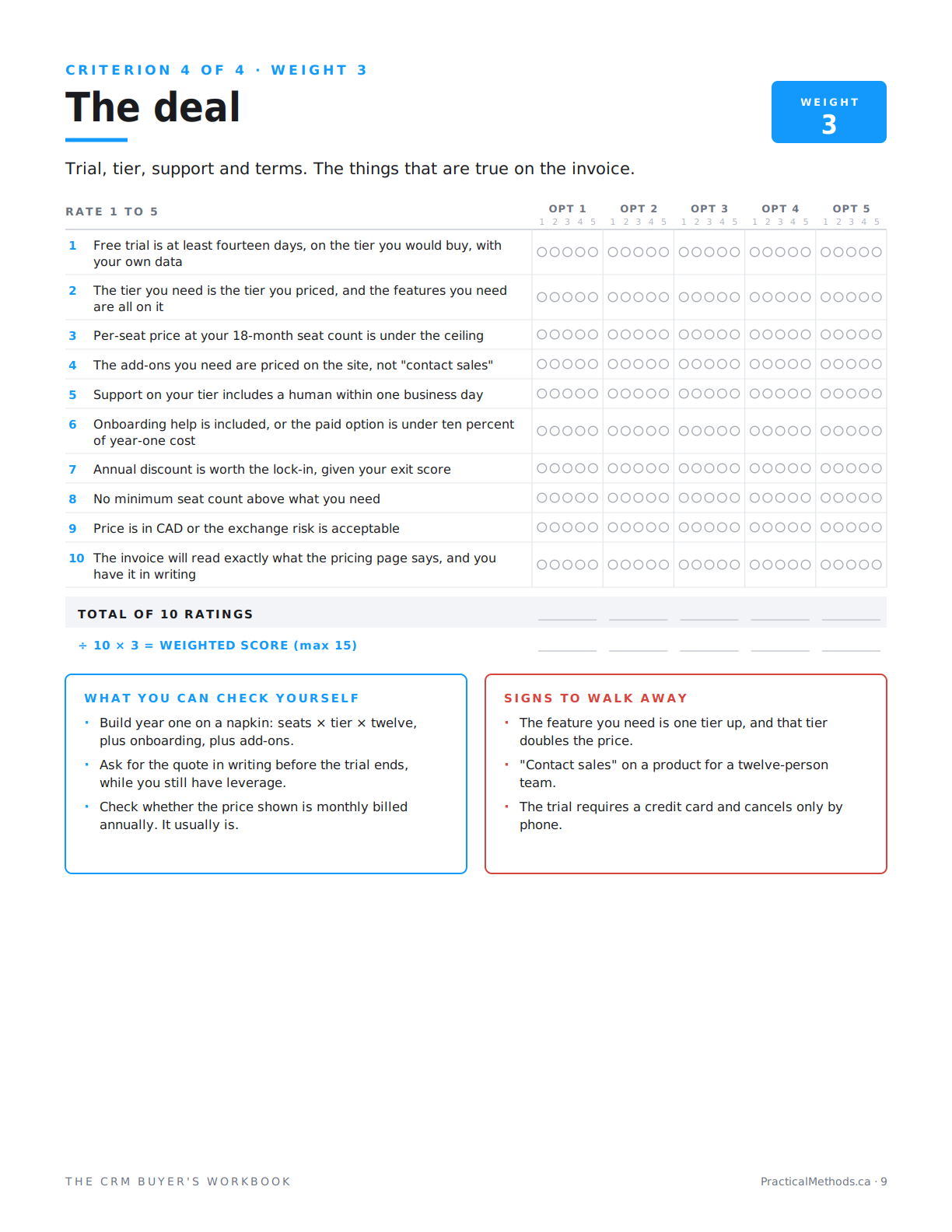
Seats at the eighteen-month count, times the tier that actually has your three jobs, times twelve. Plus onboarding. Plus the two add-ons you will turn on. Compare that number to the ceiling you wrote before you looked. Then ask for it in writing before the trial ends, while you still have leverage, and fill the terms page from the quote, not the pricing page.
Price is the weight-3 criterion in the method, the lowest, because you were always going to look at it. The job, the adoption and the exit are the ones you were not. The free series covers all four.
Read the free method
Criteria: Buying a CRM. Five articles: narrowing, the job, the adoption, the exit, the deal.
Read the free methodFrequently asked questions
How much does a CRM cost for a small team?
For six people on the entry tier with email sync, roughly $900 to $2,800 a year in US dollars on annual billing, before add-ons and onboarding. Professional tiers with automation run several times that.
Why is the advertised CRM price lower than the invoice?
The advertised price is the left-hand column, per seat, billed annually. The feature you need is usually one column right, and onboarding, add-ons and seat minimums are not on the page.
What does monthly billed annually mean?
The monthly figure is one twelfth of a single payment you make in advance for the year. Month-to-month billing costs 25 to 50 percent more where it is offered at all.
Which CRM has a free plan?
As of September 2026, HubSpot's free plan covers two users and Zoho's covers three. Pipedrive and monday CRM have no free tier. Check limits on the vendor page; free tiers change often.
What is the cheapest CRM with email sync?
On the tiers checked, monday CRM Basic and HubSpot Starter are lowest per seat, Zoho Professional next, Pipedrive Growth highest. Cheapest changes with promotions and with whether the tier's sync covers your provider.
Should I pay annually or monthly for a CRM?
Monthly costs more and is worth it in year one if you do not yet know whether the team will use the tool. Annual is worth it once the 90-day review says the adoption score was right.
What seat count should I price?
The count you expect in eighteen months. Tiers and minimums punish growth and the renewal is priced on the seats you have then.
How do I get an accurate CRM quote?
Build year one on a napkin: seats, tier, twelve months, onboarding, add-ons. Ask for the quote in writing before the trial ends. Fill the terms page from the quote, not the pricing page.
The list is not the decision. It is how you find the one or two things that are.
Not a review, not rankings, not CRM advice. A method.

