
Buying a CRM
Do you need a CRM, or a spreadsheet with a Next Action column?
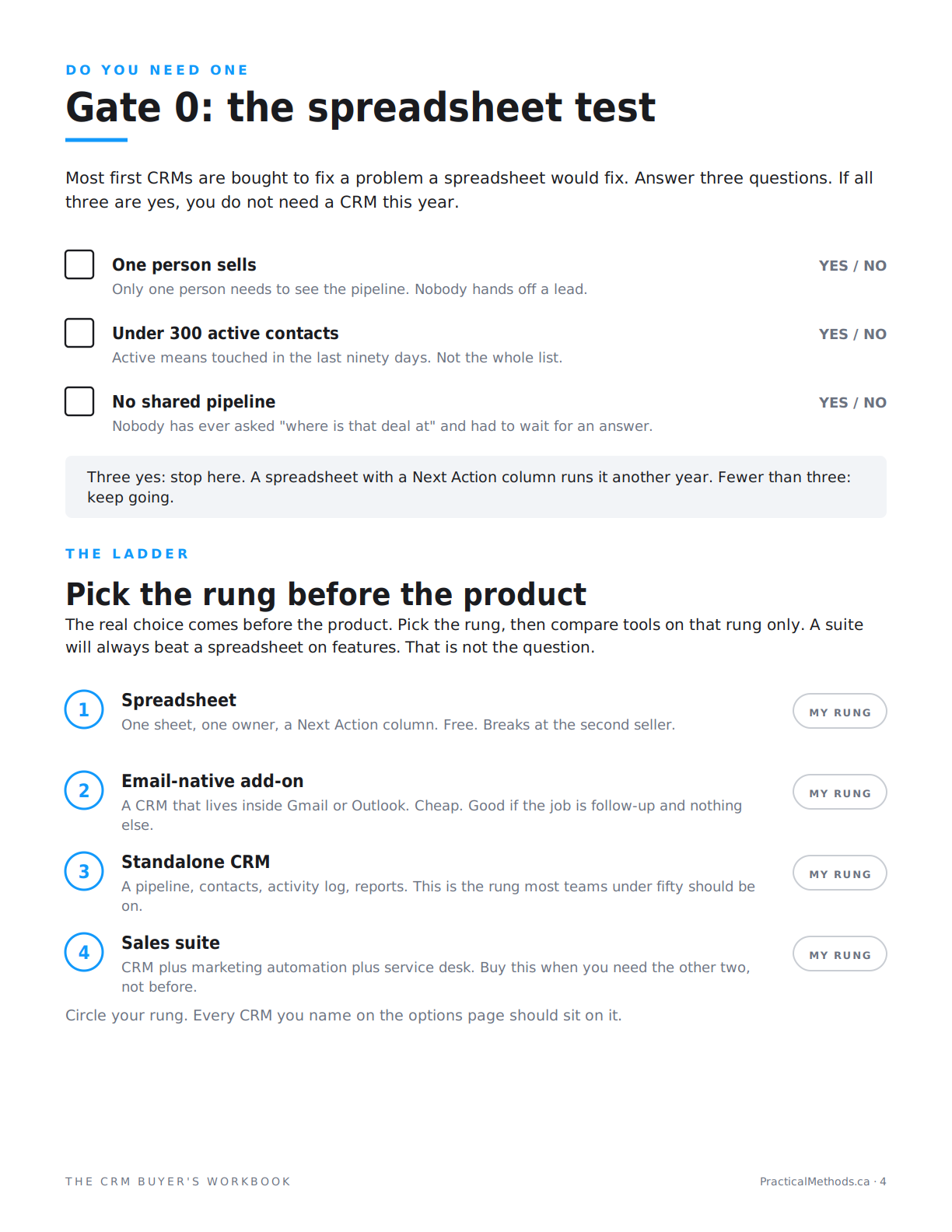
Quick answer: Most first CRMs are bought to fix a problem a spreadsheet would fix. Ask three questions. Does only one person sell? Are there fewer than 300 active contacts, meaning touched in the last ninety days? Has nobody ever asked "where is that deal at" and had to wait? Three yeses and you do not need a CRM this year. A one-tab spreadsheet with a Next Action column and a date runs it. When a second person starts selling, a free CRM tier is usually the next step, not a paid one.
Why this question comes first
Search for a CRM and every result assumes you need one. The vendors do, obviously. The review sites do, because a review of "keep using your spreadsheet" earns no commission. So the first decision, whether to buy anything at all, is the one decision nobody in the market will help you make.
That is why the method for choosing a CRM starts with a gate before the gates. Gate 0. It asks whether the problem you have is a CRM problem, or a reminder problem wearing a CRM's clothes. In practice, for a business under about ten people, it is a reminder problem more often than not.
The three-question test
Answer honestly. The test is designed so that a yes is the boring answer.
One. Does only one person sell? Not "only one person is in charge of sales." Only one person needs to see the pipeline, and nobody hands a lead to anyone else.
Two. Are there fewer than 300 active contacts? Active means touched in the last ninety days: emailed, called, quoted, met. Not the whole list. Most businesses that think they have 2,000 contacts have 150 active ones and a mailing list.
Three. Has nobody ever asked "where is that deal at" and had to wait for the answer? If the owner is the seller, the owner knows. If the answer lives in someone else's head or inbox, that is a no.
Three yeses: stop. You do not need a CRM this year. Fewer than three: keep reading, because the next question is which rung of the ladder, not which product.
The spreadsheet that passes the test
The reason spreadsheets fail as a CRM is not that they are spreadsheets. It is that the sheet is a list of contacts, and a list of contacts has no idea what should happen next. Add one column and it becomes a pipeline.
One tab. One row per open deal or live quote. Columns: name, company, what they want, value, stage, last contact date, Next Action, Next Action date, notes. Sort by Next Action date every Monday morning. Anything past due is today's work. That is the whole system.
Two rules keep it alive. Every row has a Next Action, always, even if the action is "close as lost." And the date is a real date, not "soon." A row with a blank Next Action is the deal you will forget, so the blank is the alarm.
This is not a lesser version of a CRM. For one seller and a few hundred contacts, it is a better one, because it takes ten seconds to update and lives in a tool you already open. Most of the adoption problems that kill a CRM in month four do not exist in a sheet.
Spreadsheet, free CRM, paid CRM: what each one actually adds
The honest comparison is not features. Every tier has more features than the one below it. The comparison is what each one adds that you will use, and what it costs in money and in attention.
| Spreadsheet with a Next Action column | Free CRM tier | Paid CRM | |
|---|---|---|---|
| Who it fits | One seller, under 300 active contacts | Two sellers, one pipeline | Three or more sellers, or a report the free tier cannot build |
| What it adds | Nothing you do not already have. That is the point. | Email logged from the inbox. A shared pipeline two people can trust. | Automation, reporting, integrations, more pipelines, support with a human |
| Yearly cost | $0 | $0, with limits on users, contacts and branding | Per account, per month, billed annually, on the tier that has the feature you need |
| Time to set up | Twenty minutes | An afternoon | A week for the admin, plus migration |
| Where it breaks | The second seller | The contact cap, the third user, or a report you cannot build | Month four, if nobody is logging |
| The trap | A blank Next Action cell | Assuming the free tier stays free at your size | Buying the tier one column left of the one you need |
Free-tier limits change often. HubSpot's free plan was checked September 2026: two users, one pipeline, 1,000 contacts. Verify current limits on the vendor's pricing page before deciding.
When the sheet stops working
The sheet breaks at exactly one point: the second seller. Two people updating one sheet from two inboxes is where the Next Action column starts lying, because the last contact date is whoever remembered to type it. That is the moment the answer to question one flips to no, and the day the spreadsheet test says move up a rung.
It does not say move to a paid CRM. It says move to the next rung, and the next rung for most teams is a free CRM tier: two accounts, one pipeline, email logged from the inbox. As of September 2026, HubSpot's free plan allows two users, one deal pipeline and 1,000 contacts, with Gmail and Outlook logging, which covers a two-seller team for a long time. Other vendors have comparable free tiers. Check the current limits before you rely on any of them; free tiers are the tier vendors change most often.
The paid rung is earned by three things: a third seller, a report the owner needs that the free tier cannot build, or an integration the sheet and the free tier cannot do. Not by a demo. Not by a discount that expires Friday.
Criteria: Buying a CRM
Five articles. Narrowing, the job, the adoption, the exit, the deal. Free to read.
Read the free methodThe mistakes that skip this step
Buying the tool because the salesperson did. A new hire from a company that used a CRM will ask for one on day one. Ask the three questions anyway. A CRM for one seller is a spreadsheet with a login.
Counting the whole list as active. A 2,000-name list makes a CRM look necessary. Ninety days of activity usually shrinks it under 300, and the test passes.
Confusing a mailing list with a pipeline. If the job is sending a monthly email to everyone, that is an email tool, not a CRM. Different rung, different ladder.
Skipping the sheet because it is not a real system. It is a real system. It is the system every CRM is trying to be, with a subscription attached.
What to do this week
Run the test. If it passes, build the sheet: one tab, the columns above, sorted by Next Action date. Use it for thirty days before you look at anything else. At the end of thirty days, ask the three questions again. If they still pass, you have saved a year's subscription and a migration. If one has flipped, you know which rung you are on, and the rest of the series takes it from there: six gates, four weighted criteria, and the questions the demo will not answer.
Signs to walk away
- The vendor's demo starts before anyone has asked how many people sell.
- The active contact count is the whole list, not the last ninety days.
- The reason for buying is a new hire's habit, not a job the sheet cannot do.
What to check yourself
- Count contacts touched in the last ninety days. Not the list. The ninety days.
- Build the sheet and run it for thirty days before opening a pricing page.
- Read the free tier's limits on the vendor's own pricing page, dated today.
Frequently asked questions
Do I need a CRM as a solo business owner?
Usually not this year. If one person sells, under 300 contacts are active and nobody waits for a pipeline answer, a spreadsheet with a Next Action column does the job in less time than a CRM would.
What is an active contact?
Anyone you have emailed, called, quoted or met in the last ninety days. The whole list is not active. Most small businesses have a few hundred active contacts and a much larger mailing list.
What columns should a sales tracking spreadsheet have?
Name, company, what they want, value, stage, last contact date, Next Action, Next Action date, notes. One row per open deal. Sort by Next Action date every Monday.
What is a Next Action column?
One cell per deal that says the next thing you will do and when. It turns a contact list into a pipeline. A blank cell is the deal you will forget, so blanks are the alarm.
When should I move from a spreadsheet to a CRM?
When a second person starts selling. Two people updating one sheet from two inboxes is where the dates stop being true. The next step is usually a free CRM tier, not a paid one.
Is a free CRM good enough for a small business?
For two sellers and one pipeline, often yes. Free tiers cap users, contacts and branding, and the caps change. Read the limits on the vendor's pricing page the day you decide.
When is a paid CRM worth it?
A third seller, a report the owner needs that the free tier cannot build, or an integration the sheet cannot do. A demo and an expiring discount are not on that list.
Is this a CRM recommendation?
No. It names no CRM as the answer. It is the first step of a method: decide whether you need one, then which rung, then six gates, then four weighted criteria. The full series is free on the site.
The list is not the decision. It is how you find the one or two things that are.

