Buying a CRM
A simple CRM is the one your team still uses in month four
Quick answer: Simple is not fewer features. It is fewer steps between a seller and a logged call. A CRM is simple for your team if email lands on the contact without anyone logging it, a call can be logged from a phone in under thirty seconds, the mobile app is the whole tool and not a cut-down one, a new seat takes under an hour, and the owner spends under an hour a week on admin. Twelve questions measure it. The test is a three-day trial in the hands of the seller who least wants a CRM.
What people mean by simple
Search for a simple CRM and you get tools marketed on fewer menus and a cleaner screen. That is a design opinion, and it is not what fails in month four. What fails in month four is the gap between a seller finishing a call and that call being in the system. If the gap is thirty seconds on a phone, it closes. If it is three clicks on a laptop after switching apps, it does not, and the pipeline becomes a record of whoever was diligent that week.
So simple, for the purpose of buying one, means one thing: the fewest steps between a seller and a logged activity, for the people you actually employ, on the devices they actually carry.
The twelve questions
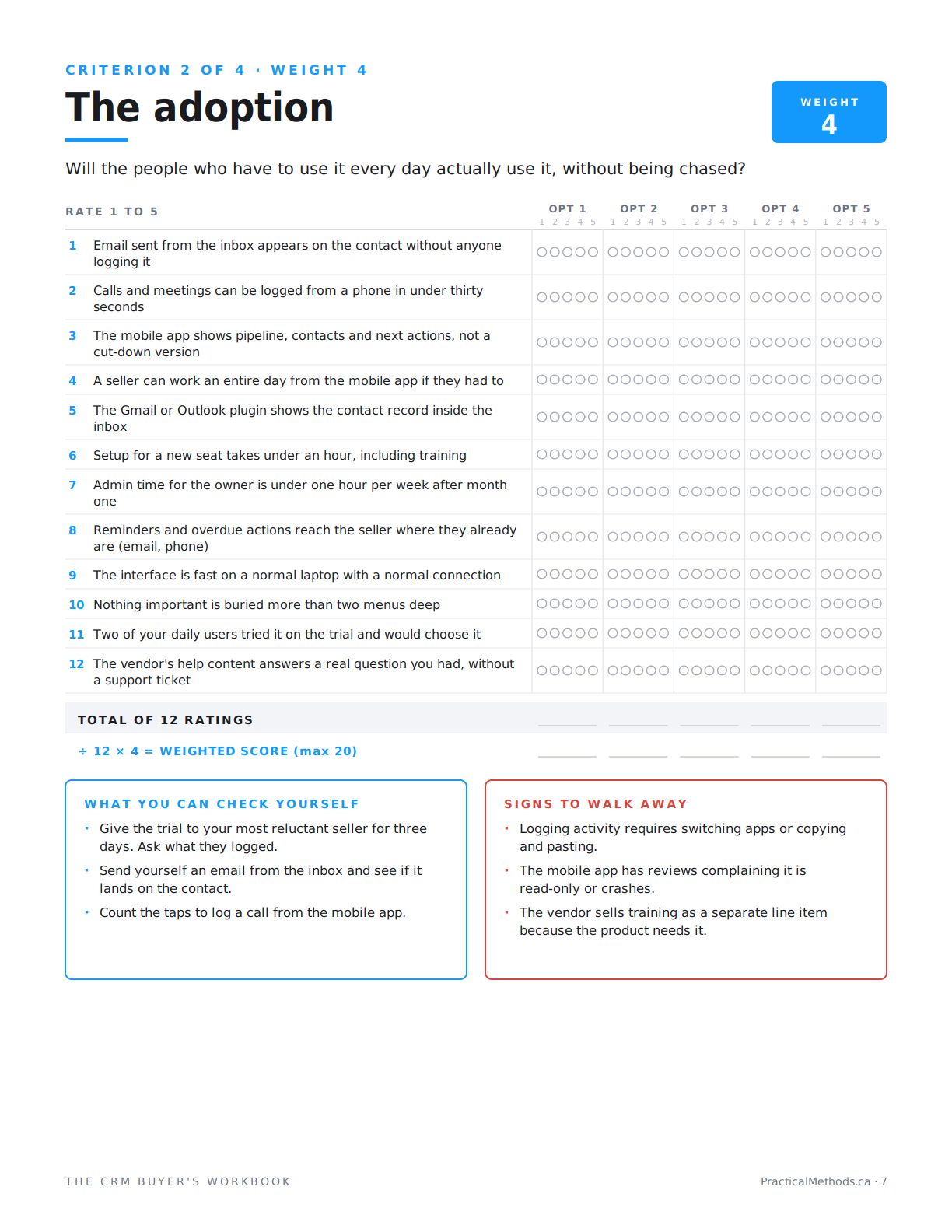
The first four are about logging without typing. Email sent from the inbox appears on the contact without anyone doing anything. Calls and meetings can be logged from a phone in under thirty seconds. The mobile app shows pipeline, contacts and next actions, not a read-only version. A seller could work a whole day from the phone if they had to.
The next four are about friction. The Gmail or Outlook plugin shows the contact record inside the inbox. Setting up a new seat, including training, takes under an hour. The owner's admin time is under an hour a week after month one. Overdue actions reach the seller where they already are, by email or notification, not in a dashboard they must open.
The last four are about people. The tool is fast on a normal laptop with a normal connection. Nothing important is buried more than two menus deep. Two of your daily users tried it and would choose it. The vendor's help content answered a real question without a support ticket.
Rate each 1 to 5. One is no or badly. Three is yes, with friction. Five is yes, cleanly, and you tested it. The word tested matters. A five from a demo is a three.
The reluctant seller test
Every team has one seller who thinks a CRM is an insult. Give that person the trial for three days. Do not coach them. At the end, open their activity log and count. That number is the adoption score. The enthusiast's opinion is worth nothing here; enthusiasts adopt anything, and the team will behave like the reluctant one.
If two tools are close on everything else, this test is the tiebreaker in the method, on purpose. It is the only measurement in the whole process that is specific to your people rather than to the product.
One more thing to count: how many of those three days the seller used the phone rather than the laptop. If the answer is all of them, the mobile app is the product, and the desktop screens the vendor demoed are decoration. Rate the app.
Simple is not the same as small
The simplest tool for your team can be a big one. A suite with excellent inbox logging and a real mobile app can be simpler in practice than a minimalist tool that needs the laptop open. The opposite is also true: a tool with three menus can still make a seller copy and paste. Judge steps, not screens.
Two tells that a product knows it is not simple: training sold as a separate line item for a team of ten, and a mobile app with reviews that say read-only or crashes. Neither is fatal on its own. Both are a point off the score.
Three things that look simple and are not
A short feature list. Fewer features often means a feature you needed is missing and the seller now keeps a second list somewhere. A clean pipeline screen. Beautiful on a laptop, irrelevant in a parking lot after a site visit. A cheap tier. The entry tier that lacks email sync is the least simple product on the market, because every email now has to be logged by hand.
And three that look complicated and are not. A suite with an excellent inbox plugin. A big tool whose mobile app does everything. A slightly higher tier that puts the owner's report on a default dashboard so nobody has to build it. Steps, not screens.
What simple cannot tell you
A tool everyone happily logs into can still be the wrong one. It might not do your three jobs. It might trap your data at renewal. Adoption is weighted 4 out of 5 in the method because a CRM nobody uses is a spreadsheet with a fee, but it is not the whole card. The job comes first, the exit sits beside it, and price sits last.
What to do this week
Send yourself an email from the inbox on the trial and see if it lands on the contact. Count the taps to log a call from the phone. Hand the trial to the reluctant seller for three days. Then rate the twelve questions with that person in the room, not the person who wanted the CRM. The rest of the method is free on the site.
Read the free method
Criteria: Buying a CRM. Five articles: narrowing, the job, the adoption, the exit, the deal.
Read the free methodFrequently asked questions
What is the simplest CRM for a small business?
The one with the fewest steps between your sellers and a logged call, on the devices they carry. That is specific to your team and is measured on the trial, not on a feature page.
Why do sales teams stop using the CRM?
Because logging takes effort and nobody is chasing it after the first quarter. If logging a call is harder than not logging it, it stops.
How many taps should it take to log a call?
Under thirty seconds from a phone, roughly five taps. Above that, calls get logged later, which usually means not at all.
Should email be logged automatically?
Yes. If sending from the inbox does not land on the contact record without a manual step, the activity history is incomplete within a month.
Who should test a CRM trial?
The seller who least wants one, for three days, uncoached. Count what they logged. Enthusiasts adopt anything.
Is paid CRM training a bad sign?
For a team under fifty, usually. A tool that needs a paid course to adopt is telling you how month four will go.
Does a simple CRM mean fewer features?
No. A large tool with excellent inbox logging can be simpler in practice than a minimal one that needs the laptop open. Judge steps, not screens.
How is adoption scored in the method?
Twelve questions rated 1 to 5, averaged, multiplied by a weight of 4. Maximum 20 of 80. The reluctant seller's activity count breaks ties.
The list is not the decision. It is how you find the one or two things that are.
Not a review, not rankings, not CRM advice. A method.

