
Buying an AI Tool
One agency, fourteen account managers, three meeting-notes tools. The playbook, filled in.
CASE STUDY
Quick answer: Northway Creative, a fifty-person marketing agency on Microsoft 365 and HubSpot, needed client call notes and next steps to land in the HubSpot record the same day without anyone typing them. They ran four tools through the AI Tool Buyer's Playbook. ChatGPT Business failed the fit gate, because it cannot capture a meeting, and was never scored. Copilot Business, Fathom Business and Fireflies Business finished within 1.2 points of each other out of 80. Fathom won on the job, Copilot won on adoption and trust, Fireflies won on the deal. The tiebreaker was three things that were never on the list: a recording bot in the client's call, who already ran HubSpot, and the fact that Copilot's notes never left Teams. They chose Fathom Business, fourteen seats, monthly for the first quarter.
The firm
Northway Creative is invented. The tools, prices and terms are not.
Fifty people in London, Ontario. Marketing agency, mostly retainer clients. Microsoft 365 Business Standard on all fifty seats, HubSpot as the CRM. Fourteen account managers run about 120 client calls a week on Teams. After each call, the account manager is supposed to put notes and next steps into the HubSpot contact record. About half of them do, a day or two later, from memory. The other half do not, and the operations lead, Jess, finds out when a client asks why nothing happened.
The COO, Marcus, asked for "an AI notetaker." Three account managers had already tried three different free ones on their own accounts, which is how the firm ended up with client recordings in three places nobody controlled. That is the point at which a method is cheaper than a purchase.
The shape, filled in
Jess and three account managers wrote the shape in forty minutes, before opening a single pricing page. Line one took most of it.
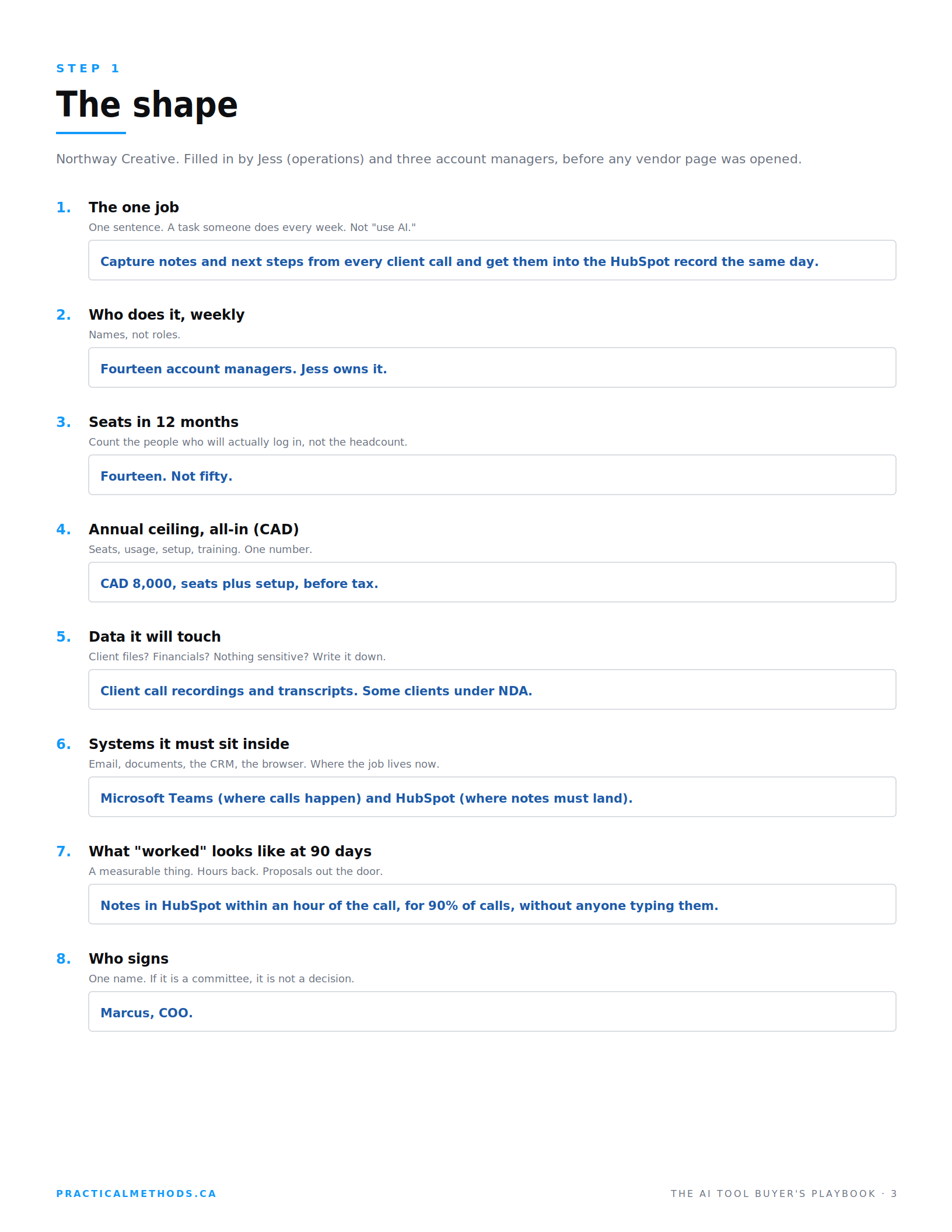
Two lines did most of the work later. Line six, the systems it must sit inside, named both Teams and HubSpot. That is what turned the fit gate into a real test. Line four, the ceiling, was set at CAD 8,000 a year all-in, which Marcus said out loud only after Jess offered CAD 15,000 and let him correct it.
Gate 0 and the ladder
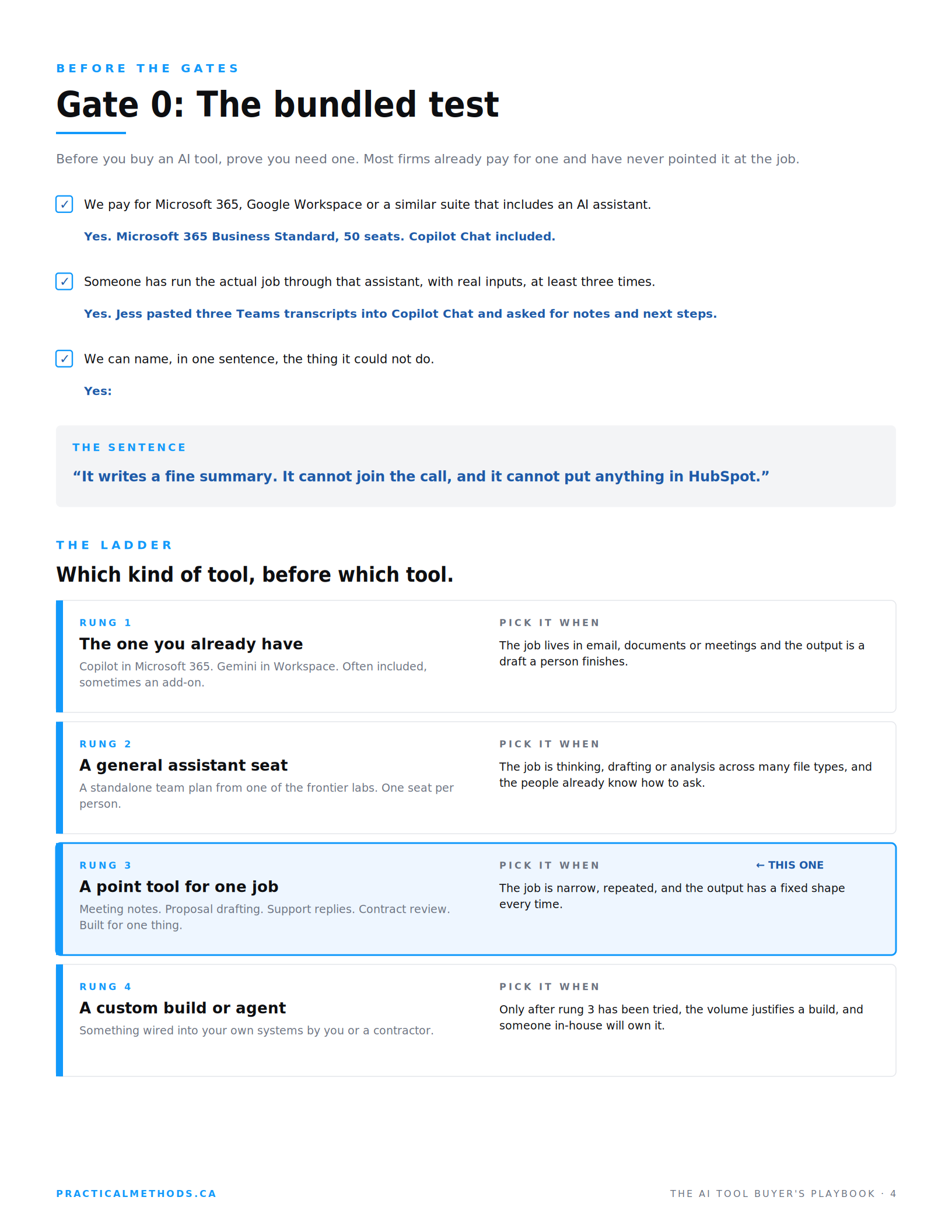
They already pay for an AI tool. Microsoft 365 Business Standard includes Copilot Chat. Jess pasted three Teams transcripts into it and asked for notes and next steps. The summaries were fine. The sentence she came back with: it cannot join the call, and it cannot put anything in HubSpot.
That sentence put the job on rung three of the ladder, a point tool for one job, with the paid Copilot add-on as the rung-one option to beat.
The options and the real prices
Four tools were shortlisted. One of each kind that could plausibly do the job, plus the one everyone assumed.
| Tool | Kind | Price (USD, per user, annual plan) | 14 seats, per year | Source | Date checked |
|---|---|---|---|---|---|
| Microsoft 365 Copilot Business | Rung one, add-on to the suite they own | USD 21 (USD 18 first-year promo) | USD 3,528, about CAD 4,833 | Microsoft pricing via secondary sources | Sept 14, 2026 |
| Fathom Business | Rung three, notetaker with HubSpot sync | USD 25 (USD 34 monthly) | USD 4,200, about CAD 5,754 | fathom.video/pricing | Sept 14, 2026 |
| Fireflies Business | Rung three, notetaker with HubSpot integration | USD 19 (USD 29 monthly) | USD 3,192, about CAD 4,373 | Fireflies pricing via secondary sources | Sept 14, 2026 |
| ChatGPT Business | Rung two, general assistant | USD 20 (USD 25 monthly) | USD 3,360, about CAD 4,603 | OpenAI pricing via secondary sources | Sept 14, 2026 |
All four are under the CAD 8,000 ceiling. CAD at 1.37, before tax, seats only. Fathom's Business tier was priced rather than Team because the HubSpot field sync lives on Business. That is the tier trap in the deal criterion, caught before the invoice rather than after.
The gates
Six gates, pass or fail, with the vendor terms pages open.
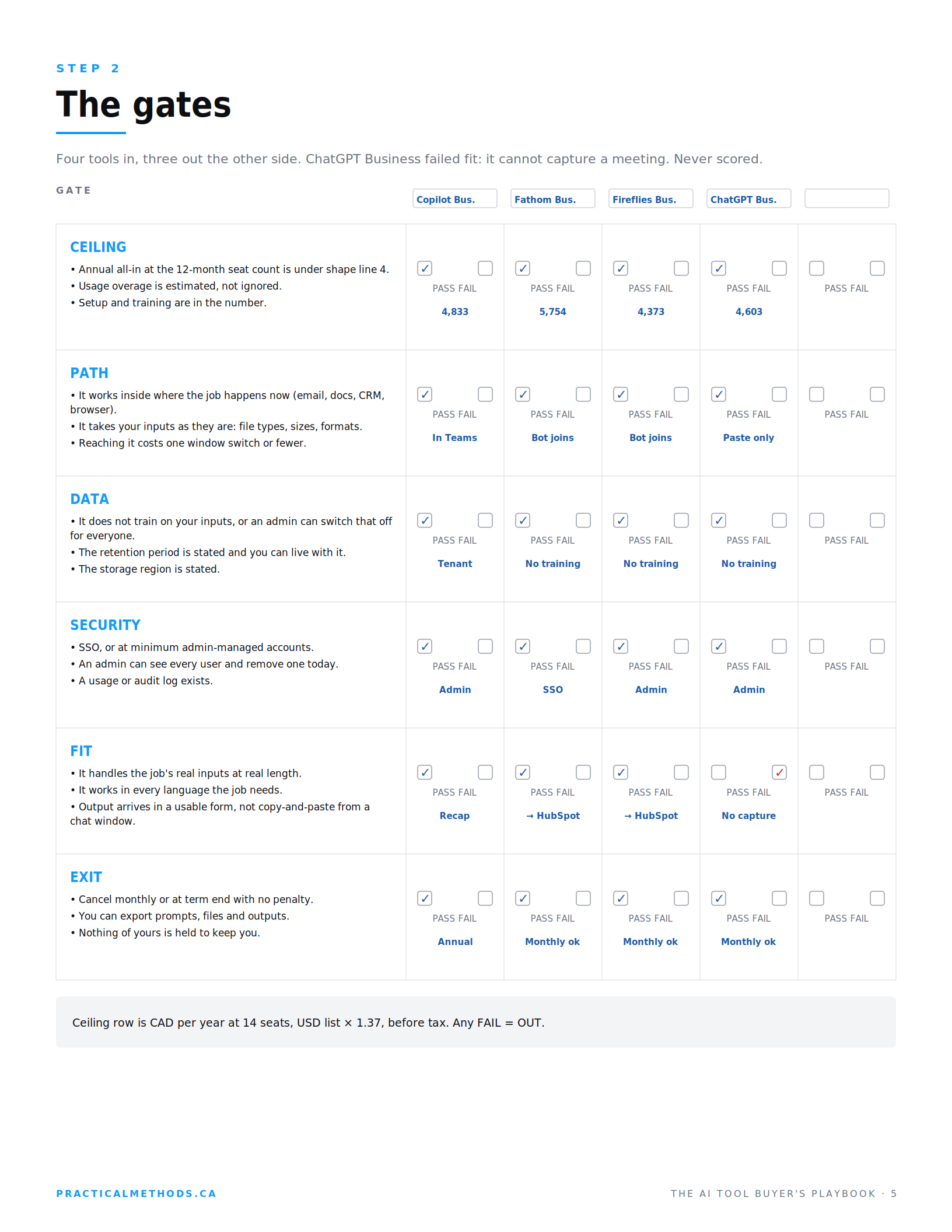
ChatGPT Business was the account managers' favourite going in. It failed fit: the job is capturing the call, and a general assistant cannot join a call. Someone would have to paste a transcript in after every meeting, which is the step the firm was trying to remove. Out at the gate, no score, no argument in the room. That is what the gates are for.
The other three passed. Data and security took the longest. All three state they do not train on business inputs by default. All three support SSO. Copilot inherits the firm's existing Microsoft permissions, which the firm already manages; Fathom's SSO is on the Business tier; Fireflies passed on admin-managed accounts. Every one of those is a line from a terms page, not a landing page.
The job, scored
Three account managers ran all three tools for two weeks on their real calls, about fourteen each. They rated the fourteen job questions from the trial, not from the demos.
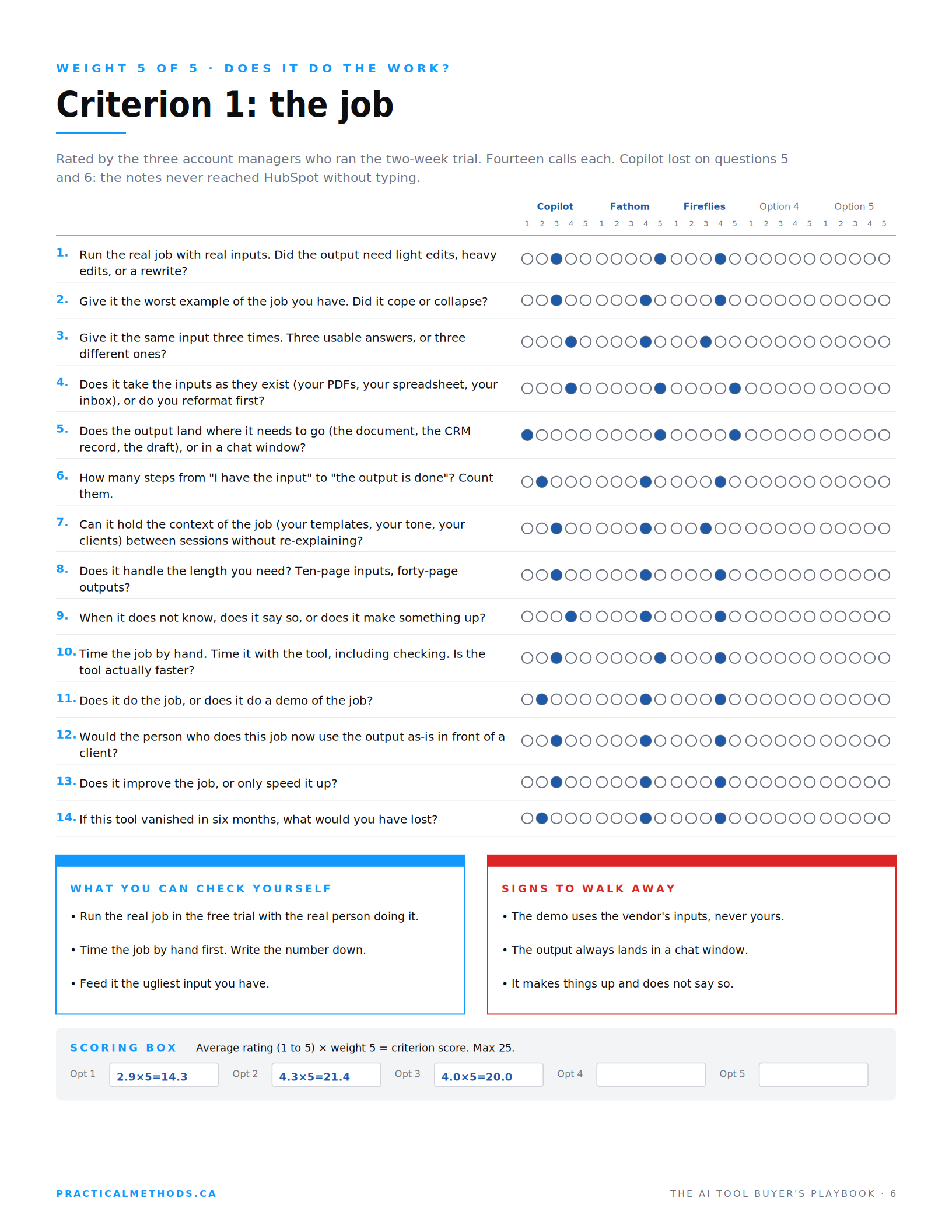
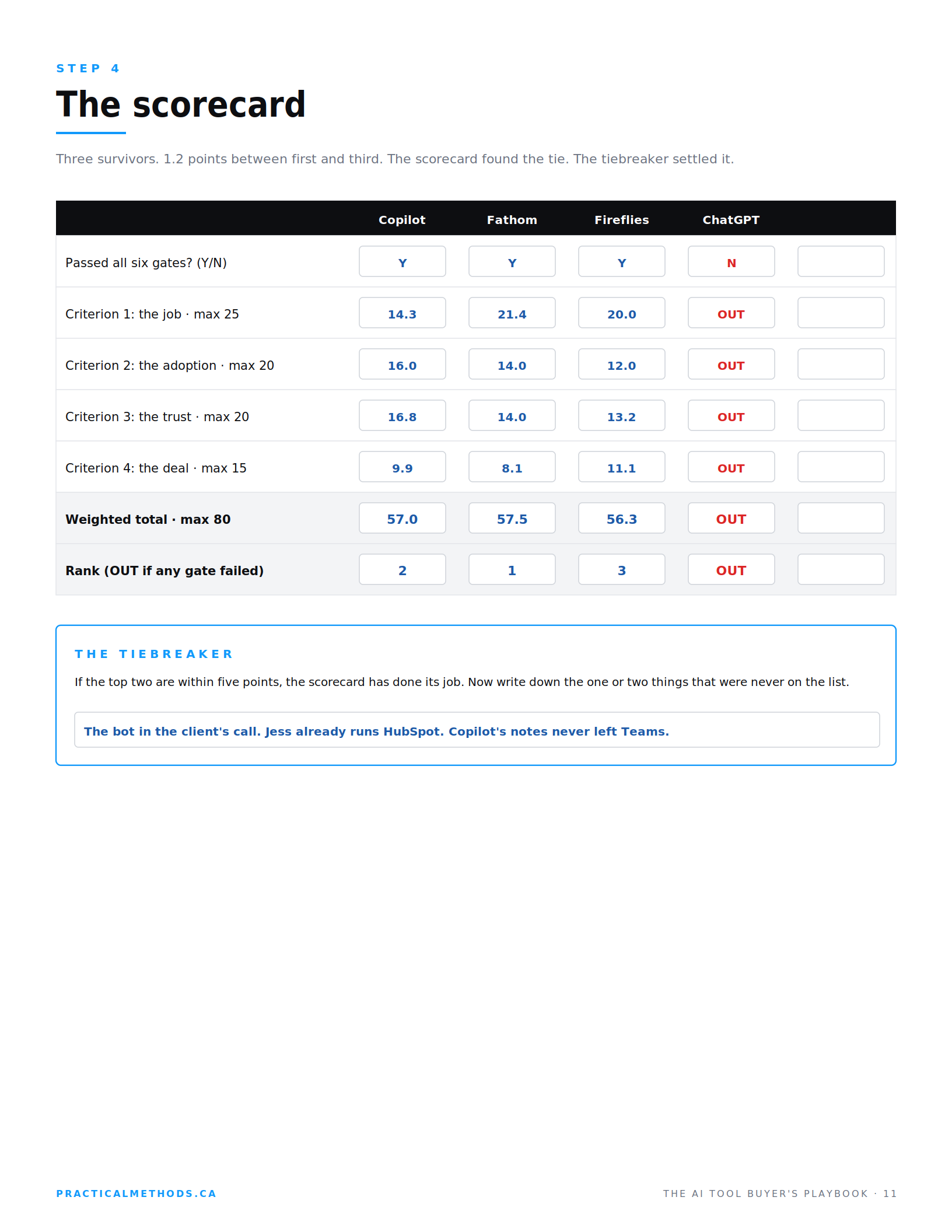
Fathom scored 21.4 of 25. Its notes and action items landed in the HubSpot record within minutes of the call, and the account managers used them as-is on most calls. Fireflies scored 20.0, close behind, with the HubSpot push needing a little more setup per person. Copilot scored 14.3. The recap in Teams was good, and it stayed in Teams. Getting it into HubSpot meant copying it, which is question five, and counting the steps, which is question six.
The rest, scored
The adoption, weight 4. Copilot 16.0. It was already in Teams, no bot joined the call, and nothing had to be set up. Fathom 14.0 and Fireflies 12.0: both put a visible recording bot in the client's meeting, and two clients asked what it was in the first week. That is a real adoption cost, and it is the kind that only shows up in a trial.
The trust, weight 4. Copilot 16.8: the firm's existing Microsoft permissions applied, and the terms were already in place. Fathom 14.0 and Fireflies 13.2: both fine on training and deletion; both required reading a new set of terms and deciding where client recordings would live.
The deal, weight 3. Fireflies 11.1, the cheapest of the three at fourteen seats. Copilot 9.9, an add-on on top of a suite they already pay for, annual commitment. Fathom 8.1, the most expensive because the HubSpot sync lives one tier up.
The scorecard
| Weight | Copilot Business | Fathom Business | Fireflies Business | ChatGPT Business | |
|---|---|---|---|---|---|
| Passed all six gates | Yes | Yes | Yes | No | |
| The job | 5 | 14.3 | 21.4 | 20.0 | OUT |
| The adoption | 4 | 16.0 | 14.0 | 12.0 | OUT |
| The trust | 4 | 16.8 | 14.0 | 13.2 | OUT |
| The deal | 3 | 9.9 | 8.1 | 11.1 | OUT |
| Total out of 80 | 57.0 | 57.5 | 56.3 | OUT | |
| Rank | 2 | 1 | 3 | OUT |
1.2 points between first and third. Anyone who tells you a scorecard makes the decision has not run one. The scorecard's job is to get you here: three tools that all do the job, and a decision that now depends on one or two things that were never on the list.
The tiebreaker
Three things, written on the scorecard page.
The bot in the client's call. Both point tools put a visible participant in every client meeting. Two clients asked. The firm decided that was manageable with one sentence in the meeting invite, but it was a real cost, and it favoured Copilot, which records nothing visible.
Jess already runs HubSpot. The tool that syncs to HubSpot has an owner on day one. The tool that lands in Teams needs a new process to get notes out of Teams, and nobody owned that.
Copilot's notes never left Teams. That was the whole job. The highest adoption and trust scores in the room belonged to a tool that did not do line one of the shape without a person typing.
What they did
Fathom Business, fourteen seats, monthly billing for the first quarter, then annual if week-three usage holds. One sentence added to every client meeting invite explaining the notetaker. Jess owns it. Marcus signed a one-paragraph decision the same day. The ninety-day review is in the calendar for December, with Copilot Business as the named fallback if clients push back on the bot.
Nothing about that decision was on the vendor comparison pages. All of it came out of the shape, the gates and a trial run by the people who do the job.
The AI Tool Buyer's Playbook
This is the playbook, filled in. The workbook pages above are the actual pages, with Northway's answers in them. Buy it and run it on your own three tools: the workbook, the Excel scorecard that does the arithmetic, the group session deck, and the facilitator's guide for running the ninety-minute meeting Jess ran.
Get the playbookIf you want to read the method first, the five articles are free at practicalmethods.ca/guides/buying-an-ai-tool.
Frequently asked questions
Is Fathom better than Copilot for meeting notes?
For this firm, on this job, Fathom scored higher on the job because its notes reached HubSpot without typing. Copilot scored higher on adoption and trust because it is already in Teams and inherits the firm's permissions. The totals were half a point apart. Which is better depends on where your notes need to land.
Why did ChatGPT fail the gate?
The job was capturing the call. ChatGPT cannot join a meeting; someone would have to paste a transcript in afterward, which is the step the firm wanted to remove. A tool that fails any gate is out and never scored.
How much does an AI notetaker cost for a team of 14?
At list prices checked September 14, 2026: Fireflies Business about USD 3,192 a year, Copilot Business about USD 3,528 on top of Microsoft 365, Fathom Business about USD 4,200. All annual plans, before tax. Verify on the vendor pages.
Does Copilot put meeting notes into HubSpot?
Not in this firm's trial. Copilot's meeting recap lands in Teams and can be copied out. Fathom and Fireflies both have HubSpot integrations on the tiers priced here.
Do clients mind a recording bot in the call?
Two of the firm's clients asked about it in the first week. The firm added one sentence to meeting invites. It was scored as a real adoption cost and was one of the three tiebreakers.
Why monthly billing when annual is cheaper?
Because the firm had not yet proved the tool would be used in week three. Monthly for the first quarter costs more per seat and lets the ninety-day review act on the evidence. The annual rate comes at renewal.
Are these scores real?
They are one invented firm's trial, built to show the method with real tools and real prices, and flagged as such. Your account managers, your clients and your CRM will score differently. That is why the playbook has blank pages.
What is in the AI Tool Buyer's Playbook?
The twelve-page workbook shown on this page, blank; an Excel scorecard that calculates weighted totals and marks failed gates as OUT; a fifteen-slide group session deck; and a facilitator's guide for running the decision with the team in ninety minutes. One download, $49.
The AI Tool Buyer's Playbook
The workbook above, blank, plus the Excel, the deck and the guide.
Get the playbookThe list is not the decision. It is how you find the one or two things that are.
Not a review, not rankings, not software advice. A method.

