
Buying an AI Tool
AI tool pricing, per seat vs usage: how to get to one annual number
Quick answer: normalise every option to one annual all-in number in Canadian dollars: seats times price times twelve, plus estimated usage, plus setup, plus the tier you actually need, not the tier on the home page. Then ask which pricing model gets expensive if the tool works, what the bundled tool costs for the same job (zero is a real number), and what the price is at double the seats. Eight questions, weight three.
3 out of five.
3 out of five.
Why the deal is weighted three
The deal is the last criterion and the lightest, at three. Not because money does not matter, but because a tool that does the job, gets used, and can be trusted is worth paying for, and a tool that fails any of those is not worth having free. The ceiling gate has already removed anything you cannot afford. What is left is choosing well among tools you can.
The deal is also where AI tools are hardest to compare. Per-seat, usage-based and bundled pricing all live in the same market. A tool that is cheap per seat may be expensive per use. A tool that is included in a suite you already pay for costs nothing extra and is rarely on the comparison. Getting to one number per tool is most of the work.
One annual number
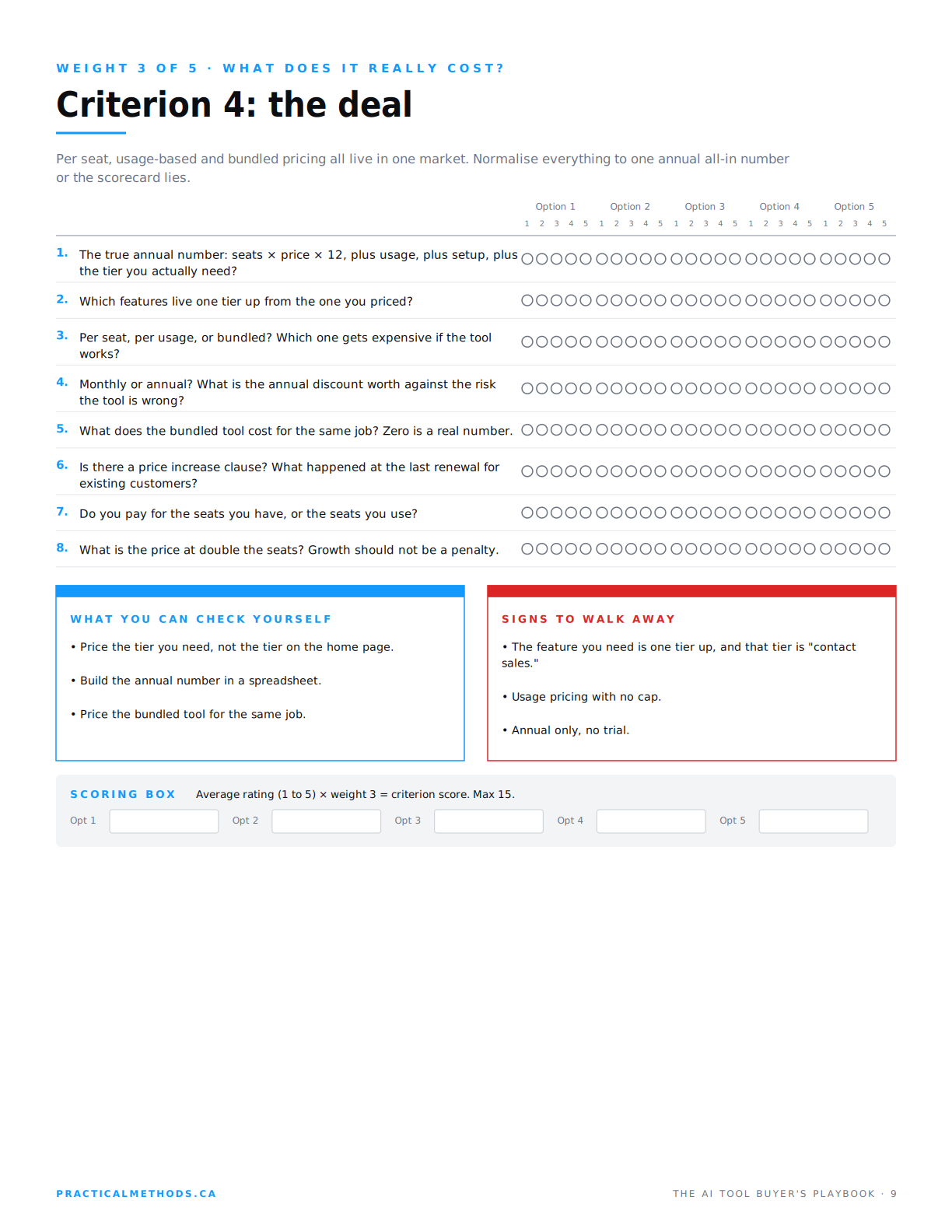
Question one is the arithmetic. Seats, at the twelve-month count from the shape, times the monthly price, times twelve. Plus usage: estimate it from the trial, at the real frequency, and add a margin. Plus setup and any training you will pay for. Plus the difference between the tier on the home page and the tier that has the feature you need. Build it in a spreadsheet, per tool, in the same currency, and date it.
The AI Tool Buyer's Playbook
Six gates. Four weighted criteria. Five tools. $49, one download.
Get the playbook · $49Question two is the tier trap. Which features live one tier up from the one you priced? Single sign-on, admin controls, the audit log and the data-training switch have a habit of living in the tier labelled "contact sales." If the feature is a gate requirement, the tier that has it is the tier you are pricing.
Which model gets expensive if it works
Question three is the one most buyers do not ask until the second invoice. Per seat, per usage, or bundled: which one gets expensive if the tool works? Usage pricing is cheap in the trial and expensive in month four, when the team is actually using it. Per-seat pricing is predictable and punishes growth. Bundled pricing is often the cheapest and is the one nobody compares against.
Question five is the comparison nobody makes. What does the bundled tool cost for the same job? If you already pay for a suite, the marginal cost of its assistant may be zero or a small add-on. Zero is a real number. Put it on the scorecard next to the others and let it compete.
A worked number
Illustrative only, not a quote. Eight seats at a per-seat rate of forty dollars a month is three thousand eight hundred and forty dollars a year. Add estimated usage from the trial, say six hundred dollars. Add an afternoon of setup and one training session, call it five hundred. Add the difference to the tier with single sign-on, another nine hundred and sixty. The pricing page said forty dollars a seat. The scorecard says five thousand nine hundred dollars, all-in, against a ceiling that was set before anyone opened the pricing page. Now price the bundled assistant for the same eight people, and put both numbers in the same column.
Terms, renewals and growth
Question four: monthly or annual? An annual discount is worth something, and it is worth less than the risk that the tool is wrong. On a first purchase, monthly for the first quarter is usually the better deal even at a higher rate, because the 90-day review can act on it. Question six: is there a price increase clause, and what happened at the last renewal for existing customers? The trust criterion scored the behaviour. The deal prices it.
Question seven: do you pay for the seats you have or the seats you use? A tool that bills assigned seats, used or not, needs an owner who reviews seats monthly. Question eight: what is the price at double the seats? Growth should not be a penalty. If the price per seat goes up as the count goes up, the vendor's incentives are pointed away from yours.
Scoring it, and what comes after
Average the eight ratings, multiply by three, and carry the score to the scorecard. Then total the four criteria out of eighty and rank. Any tool that failed a gate is out and gets no rank, whatever it scored. If the top two are within five points, the method has worked: the scorecard has told you the decision is about one or two things that were never on the list. Name them. Pick on them. Then read the terms page before anyone signs, put the 90-day review in the calendar, and re-run gate 0 when it arrives.
Signs to walk away
- The feature you need is one tier up, and that tier doubles the price.
- "Contact sales" on a product for a twelve-person team.
- The trial requires a credit card and cancels only by phone.
What to check yourself
- Build year one on a napkin: seats times tier times twelve, plus onboarding, plus add-ons.
- Ask for the quote in writing before the trial ends, while you still have leverage.
- Check whether the price shown is monthly billed annually. It usually is.
The series
- How to choose an AI tool for your business without buying five
- How to test an AI tool before buying: the job comes first
- Why employees don't use AI tools, and how to score for it before buying
- AI tool data privacy checklist for a small business: the trust criterion
- AI tool pricing, per seat vs usage: how to get to one annual number
Frequently asked questions
Is per-seat or usage pricing better for a small business?
Per-seat is predictable and usage is cheaper at low volume. The question is which gets expensive if the tool works. Estimate usage from the trial at real frequency and price both models at month six, not month one.
Should I sign an annual contract for the discount?
Not on a first purchase. Monthly for the first quarter costs more per month and lets the 90-day review act. Take the annual discount at renewal, once week-three usage has proven the tool is used.
How do I estimate usage costs?
Count runs in the trial, multiply by the twelve-month frequency of the job, apply the vendor's usage rate, and add a third for growth. If the vendor cannot give you a rate you can multiply, that is a finding.
What if the feature I need is only in the enterprise tier?
Then the enterprise tier is the price. Do not price the lower tier and hope. If the enterprise tier breaks the ceiling, the tool fails the ceiling gate and is out.
Is the bundled tool really free?
Often it is included in a plan you already pay for, sometimes it is an add-on per user. Either way it is usually the cheapest option on the list and should be priced and scored like the others, not assumed away.
What is a fair price for an AI tool?
There is no fair price. There is the ceiling in the shape, and the annual all-in number for each tool that survived the gates. A tool under the ceiling that scores well on the job, the adoption and the trust is worth its number.
How should I handle a price increase clause?
Read it. If the vendor can raise prices at renewal without a cap, rate question six low and plan for it in the ceiling. Search the vendor's history for what they did last time. That is the best predictor.
What if two tools tie on the scorecard?
That is the method working. Write down the one or two things that were never on the list: who owns it, what cannot be exported, which vendor answered the phone. Decide on those, and write the reason down.
\nThe list is not the decision. It is how you find the one or two things that are.

