
Buying an AI Tool
Why employees don't use AI tools, and how to score for it before buying
Quick answer: the standard failure of an AI tool purchase is not that it does not work. It is that nobody opens it in week three. Score for adoption before buying: who asked for it, who ran the trial, how many people used it in week three unprompted, whether it lives inside the tool they already have open, how long from login to first useful output, who owns it afterward, and what the plan is for the person who refuses. Twelve questions, weight four.
4 out of five.
4 out of five.
The failure that does not show on the invoice
AI tools rarely fail loudly. They fail by going quiet. The subscription renews, the seats stay assigned, and usage drops to one person by the end of the first month. The tool did the job in the trial. The people did not do the tool. That is why adoption carries a weight of four in this method, second only to the job itself, and why it is scored from the people rather than the software.
Who asked for this?
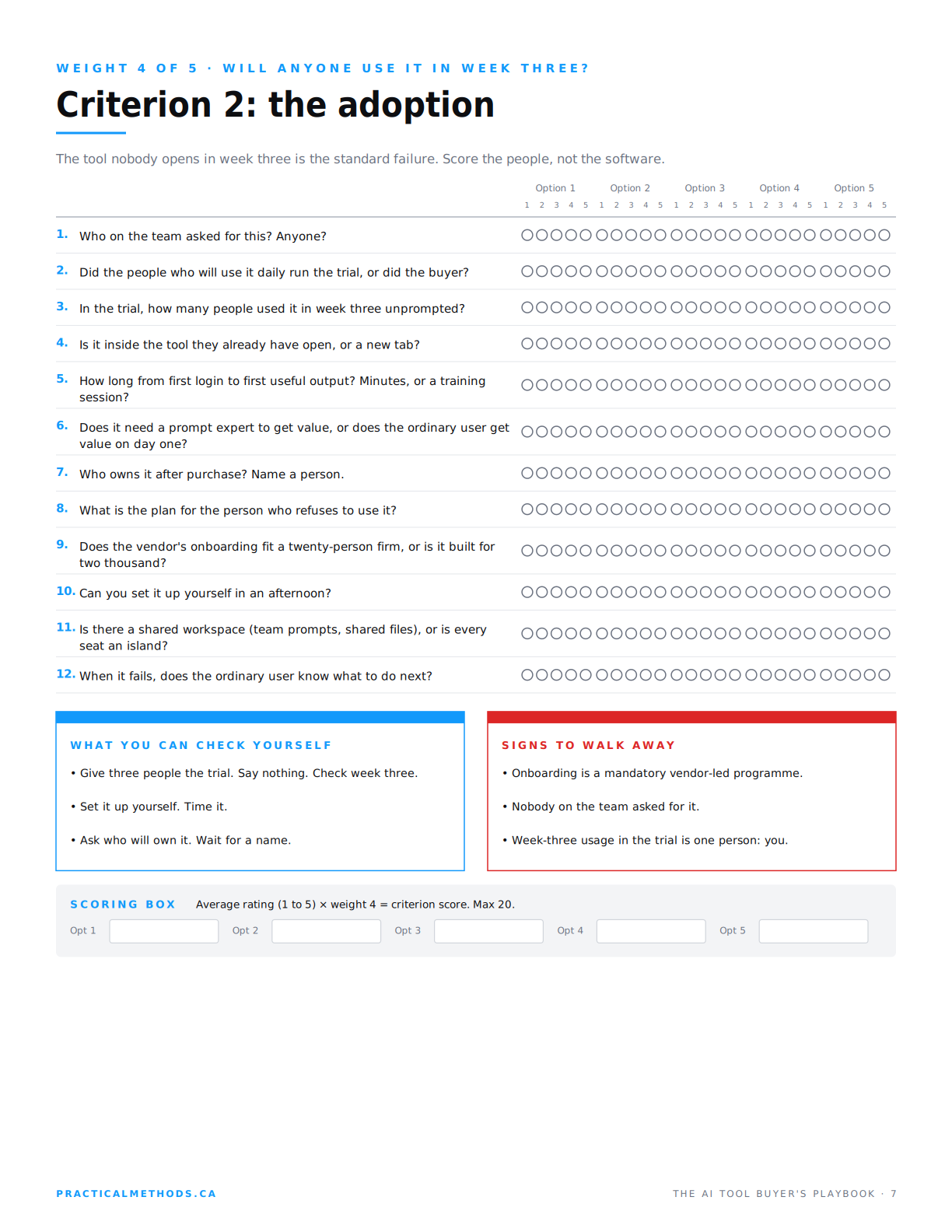
The first question on the list is the one most purchases skip. Who on the team asked for this? If the answer is nobody, and the tool was chosen by the owner after a conference or a LinkedIn post, adoption starts from behind. That is not fatal. It is a rating of two on question one, and it means the trial had better be run by the team, not for them.
Question two follows from it. Did the people who will use it daily run the trial, or did the buyer? A trial run by the buyer produces a score from the buyer. The people who will use the tool have not been asked yet.
The week-three test
Give three people the trial. Say nothing. Do not send reminders, do not schedule check-ins, do not ask how it is going. At the end of week three, look at the usage log and count the people who used it that week without being prompted. That number is the adoption score, and no vendor onboarding session will change it.
The AI Tool Buyer's Playbook
Six gates. Four weighted criteria. Five tools. $49, one download.
Get the playbook · $49One person: the tool is a personal productivity habit for one enthusiast, and should be priced as one seat. Two of three: real. Three of three: buy it. Zero: the tool may still be excellent, and it will be excellent alone.
New tab or same tab
Question four is structural. Is the tool inside what the team already has open, or is it a new tab? Every new tab is a decision to switch, and decisions get skipped on busy afternoons. This is why rung-one tools, the ones bundled into the suite, win adoption scores they lose on capability. They are already there.
Questions five and six measure the distance from login to value. Minutes, or a training session? Does the ordinary user get something useful on day one, or does it need a prompt expert? A tool that needs a specialist has one user, and that user will leave.
The bundled tool's unfair advantage
The assistant inside the suite you already pay for will score well on questions four, five and ten without trying. Same tab. Minutes to first output. Nothing to set up. Some buyers feel that is unfair to the point tools. It is not. It is the reason point tools fail quietly in small firms, and it is the reason the bundled test is gate 0. A point tool that beats the bundled assistant on the job by a wide margin can afford to lose here. One that beats it narrowly usually cannot.
Name the owner and the refuser
Question seven asks who owns the tool after purchase. A name. If the room cannot produce one, adoption will not be managed, seats will not be reviewed, and the 90-day review will not happen. Question eight is the one nobody wants to write down: what is the plan for the person who refuses to use it? There is always one, and the answer is usually a path or fit problem the tool has, not a personality problem the person has. Ask them what would have to be true. Write it down.
The last four questions are about the vendor and the setup. Whether onboarding is built for a twenty-person firm or a two-thousand-person one. Whether you can set it up yourself in an afternoon. Whether there is a shared workspace or every seat is an island. And whether, when it fails, the ordinary user knows what to do next. Rate them from the trial. Average the twelve, multiply by four, and carry the score to the scorecard.
Signs to walk away
- Logging activity requires switching apps or copying and pasting.
- The mobile app has reviews complaining it is read-only or crashes.
- The vendor sells training as a separate line item because the product needs it.
What to check yourself
- Give the trial to your most reluctant seller for three days. Ask what they logged.
- Send yourself an email from the inbox and see if it lands on the contact.
- Count the taps to log a call from the mobile app.
The series
- How to choose an AI tool for your business without buying five
- How to test an AI tool before buying: the job comes first
- Why employees don't use AI tools, and how to score for it before buying
- AI tool data privacy checklist for a small business: the trust criterion
- AI tool pricing, per seat vs usage: how to get to one annual number
Frequently asked questions
What is a good adoption score?
Above four on average is rare and usually means the tool is bundled into something the team already uses. Three to four is normal for a point tool the team asked for. Under three means the tool will be one person's habit within a quarter, and should be priced as one seat.
Should I run the trial with the whole team?
Three people is enough. Pick the person who does the job most, the person most sceptical of it, and one in between. If all three use it in week three, the rest will follow.
What if only the owner uses it?
Then it is a one-seat tool, and that is a fine outcome if it is priced as one. The mistake is buying twenty seats on the strength of one person's enthusiasm.
Does training fix low adoption?
Sometimes, for a while. Training fixes not knowing how. It does not fix a tool that lives in the wrong place or produces output that needs to be copied somewhere else. Score the structural questions first.
Is a new tab really that bad?
It is the single most reliable predictor of quiet failure. A tool in a new tab competes with everything else in a new tab. A tool inside the document wins by being where the work already is.
How do I handle the person who refuses?
Ask what would have to be true for them to use it. The answer is usually specific and usually a real weakness in the tool. Treat it as a finding, not a complaint.
Should adoption outweigh the job?
No. The job is weighted five for a reason. But a tool that does the job and nobody uses is the same as a tool that does not do the job, which is why adoption is next at four. The weights are yours to change if your situation argues for it.
What if the vendor's onboarding is mandatory?
Rate question nine accordingly. Mandatory vendor-led onboarding is built for large firms and is a sign the tool expects an admin you do not have. It is also a sign the setup cannot be done in an afternoon, which is question ten.
The list is not the decision. It is how you find the one or two things that are.

