
Buying a CRM
The deal: the hidden costs in CRM pricing, and what to get in writing
Quick answer: The deal is the weight-3 criterion because price is the thing most buyers already look at, and the trap is not the price but the tier. Ten questions: is the trial on the tier you would buy, are the features you need all on that tier, is the per-seat price at your eighteen-month seat count under the ceiling, are add-ons priced on the site, does support include a human within a business day, and will the invoice match the pricing page, in writing. Build year one on a napkin before you read the quote.
3 out of five.
Why the deal is weighted lowest
Not because price does not matter. Because price is the thing you were always going to look at, and the method exists to make you look at the things you were not. The deal is weighted 3 so that a cheap tool that fails the job cannot win on price, and an expensive one that does everything cannot be excused by it. The gates already removed anything over the ceiling. The deal criterion is about what is true on the invoice.
The tier trap
Every CRM pricing page has three or four columns. The price you remember is the left-hand column. The features you need are in the second or third. This is not an accident. The question is not what the tool costs. It is what the tier that does your three jobs costs, at the seat count you will have in eighteen months, billed the way the small print says.
The small print usually says the monthly price is billed annually. So the number on the page is a twelfth of a bill you pay once, in advance, for a year, on a tool you have used for fourteen days.
The CRM Buyer's Playbook
The workbook, the Excel scorecard, the session deck and the facilitator's guide. Run it with your team in ninety minutes.
Get the Playbook · $49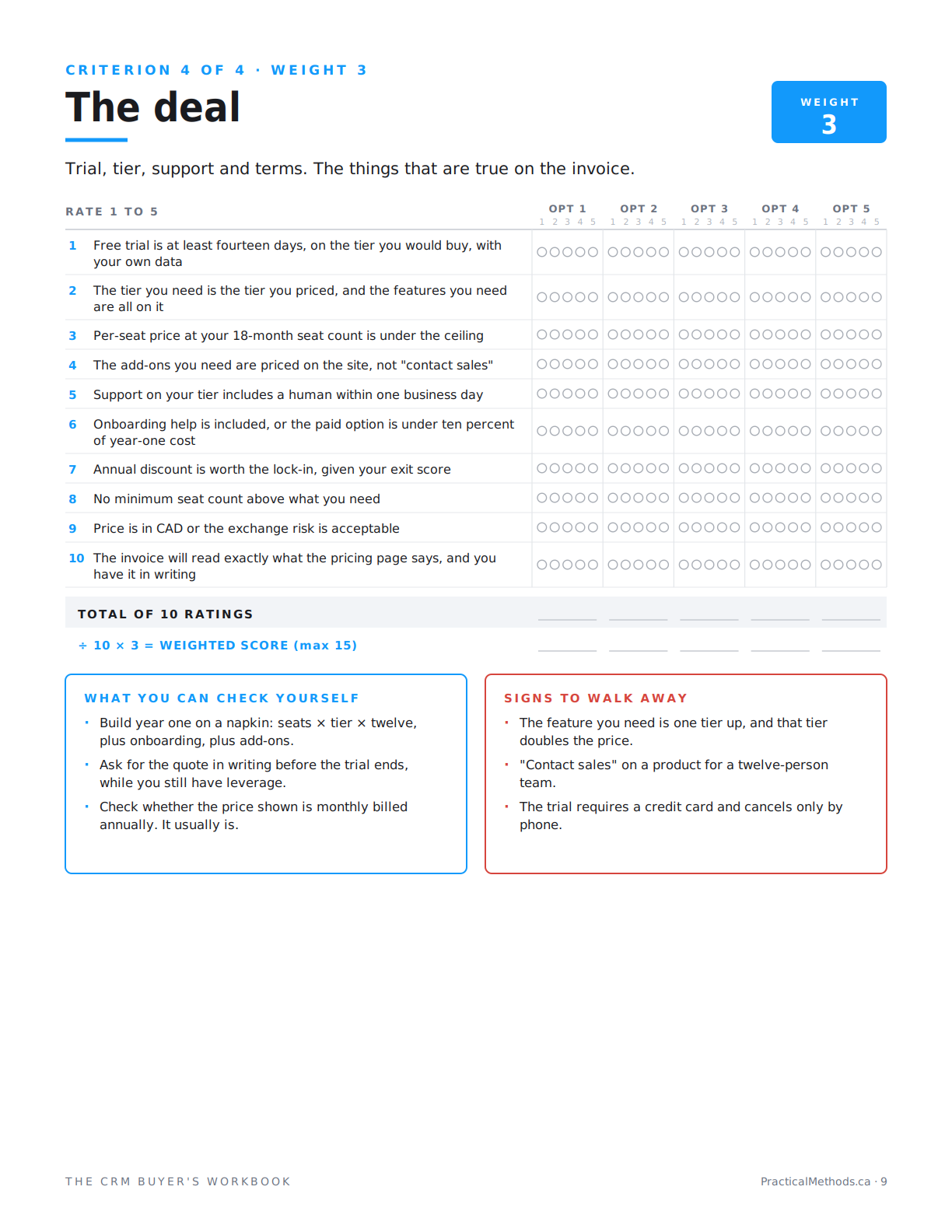
The ten questions
The first three are about the tier. The free trial is at least fourteen days, on the tier you would buy, with your own data. The tier you need is the tier you priced, and every feature you need is on it. The per-seat price at your eighteen-month seat count is under the ceiling.
The next four are about what is not on the page. The add-ons you need are priced on the site, not behind "contact sales." Support on your tier includes a human within one business day. Onboarding help is included, or the paid option is under ten percent of year-one cost. And the annual discount is worth the lock-in, which you can only judge with the exit score in front of you.
The last three are about the invoice. No minimum seat count above what you need. Price in your currency, or exchange risk you can accept. And the invoice will read exactly what the pricing page says, and you have it in writing before the trial ends, while you still have leverage.
The napkin
Seats, times tier price, times twelve. Plus onboarding. Plus the two add-ons. That is year one. Do it before you ask for a quote. If the quote is higher than the napkin, one of you has misread the pricing page, and the conversation about which one is the most useful conversation you will have with the vendor.
Get it in writing
Ask for the quote in writing before the trial ends. A vendor who will not put the price in writing while you are still deciding is telling you what the renewal will be like. The written quote is also what fills the terms page in the workbook, and the terms page is what you sign against, not the pricing page.
Add it up
The job out of 25. Adoption out of 20. Exit out of 20. The deal out of 15. Eighty points. Any option that failed a gate is out and gets no rank. If two are within five points, that is a tie, and ties go to the tiebreaker: the tool your most reluctant seller logged more activity in. Then ask which one or two questions actually moved the score. That is the decision. The list was how you found it.
| Criterion | Weight | CRM A | CRM B | CRM C |
|---|---|---|---|---|
| Gates | Pass | Pass | OUT | |
| The job | 5 | 21.4 | 19.6 | 22.1 |
| The adoption | 4 | 13.3 | 16.7 | 14.0 |
| The exit | 4 | 16.0 | 14.8 | 8.8 |
| The deal | 3 | 10.2 | 11.1 | 12.6 |
| Total / 80 | 60.9 2 | 62.2 1 | OUT |
Illustrative numbers. CRM C scored highest on the job and failed the exit gate, so it never ranked. A and B are within five points, which is a tie, and ties go to the tiebreaker.
Six line items that are not on the pricing page
Onboarding or implementation, sometimes mandatory on the tier you need. Migration from your current spreadsheet or tool, sometimes quoted separately. The add-ons for the features that were one tier up: reporting, sequences, calling. A seat minimum that rounds your twelve up to fifteen. Premium support, if the standard tier has no human. And the currency, if you are billed in dollars that are not yours.
Put each one on the napkin. Most of them will be zero. The ones that are not are the difference between the price you remember and the invoice you will pay, and they are cheaper to find on a napkin than on the invoice.
How to run this in the room
The deal is the fastest criterion to score because most of it is arithmetic. Do the napkin on the screen: seats, tier, twelve months, onboarding, add-ons. Compare it to the ceiling from the shape. If any option is over, it should already have failed the ceiling gate; if it did not, the gate was scored on the starter tier and needs to be run again.
Then ask for the written quote before the trial ends. That is an action item for the owner, with a date, and the terms page in the workbook is filled from it. The scorecard is done in the room. The signature waits for the quote.
If the quote comes back higher than the napkin, that is not a reason to drop the option. It is a reason to ask the vendor which line they added, and to add it to the ceiling gate for every option so the comparison stays fair. Most quote surprises are the same three items across the market: onboarding, a seat minimum and the reporting add-on. A napkin that includes them for everyone is a napkin that predicts the invoice.
Signs to walk away
- The feature you need is one tier up, and that tier doubles the price.
- "Contact sales" on a product for a twelve-person team.
- The trial requires a credit card and cancels only by phone.
What to check yourself
- Build year one on a napkin: seats times tier times twelve, plus onboarding, plus add-ons.
- Ask for the quote in writing before the trial ends, while you still have leverage.
- Check whether the price shown is monthly billed annually. It usually is.
Run it
The CRM Buyer's Playbook. Six gates. Four weighted criteria. Five CRMs. One room.
The series
- How to choose a CRM for a small business: narrow first
- The job: a CRM requirements checklist that ignores the feature page
- The adoption: why sales teams stop using the CRM
- The exit: what it costs to leave a CRM, checked before you sign
- The deal: the hidden costs in CRM pricing, and what to get in writing
Frequently asked questions
Why is price weighted lowest?
Because you were always going to look at it. The gates already removed anything over the ceiling. The deal criterion scores what is true on the invoice, and a low weight stops a cheap tool winning on price alone.
What is the tier trap?
The price you remember is the left-hand column. The features you need are in the second or third. Price the tier that does your three jobs, not the starter tier.
What seat count should I price?
The count you expect in eighteen months. Tiers and minimums punish growth, and the renewal is priced on the seats you have then.
What does monthly billed annually mean?
The number on the page is one twelfth of a bill you pay once, in advance, for the year. Check before you compare it to a true monthly price.
Should onboarding be free?
Included, or priced under ten percent of year one. Above that, the tool is telling you it is hard to set up.
When should I ask for the written quote?
Before the trial ends. That is when you have leverage. A vendor who will not write it down then will not be flexible at renewal.
How is the deal weighted?
Three out of five. Average the ten ratings and multiply by three. Maximum 15.
What is the total score out of?
Eighty. The job 25, adoption 20, exit 20, the deal 15. Gate failures are out and get no rank.
The list is not the decision. It is how you find the one or two things that are.

