
Buying a CRM
The exit: what it costs to leave a CRM, checked before you sign
Quick answer: The cheapest time to check what leaving a CRM costs is before you buy it. The exit criterion asks ten questions: does the export include notes and activity history or just contacts, can you run it yourself today, is the renewal increase capped in writing, is the term your choice, and is cancellation a setting rather than a phone call. Weighted 4. Run the export on the trial and open the file before the trial ends.
4 out of five.
Why exit is weighted as heavily as adoption
A CRM is bought once and paid for every month. The price you agreed to is the price for year one. After that, the price is whatever the renewal clause says it is, and your negotiating position is whatever your export looks like. If leaving means losing three years of notes and activity history, you will pay the increase. The vendor knows this. The exit criterion is where you find out before they do.
It is weighted 4, the same as adoption, because lock-in is the single most expensive thing that can happen to a small business's software budget, and it happens quietly.
The ten questions
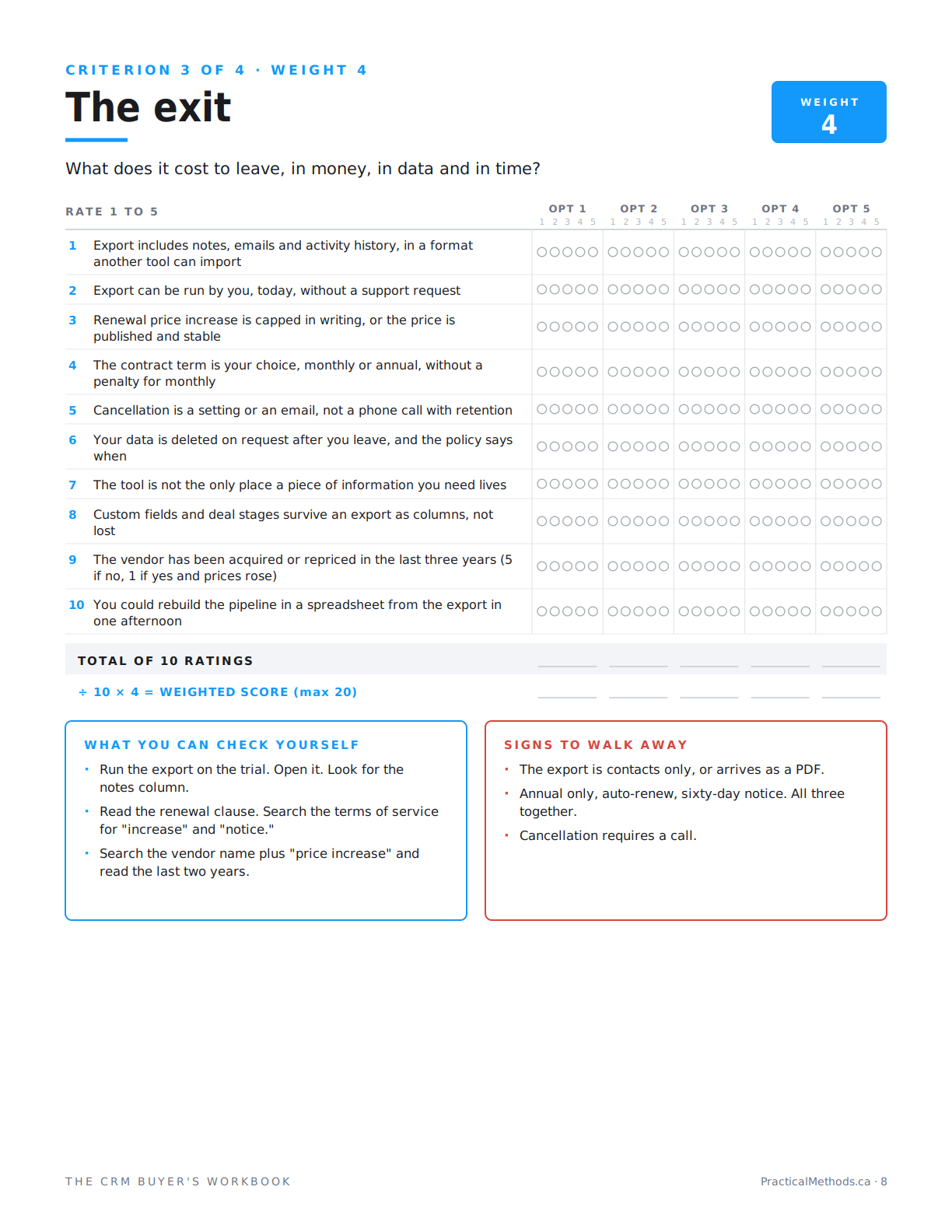
The first three are about the export. It includes notes, emails and activity history, in a format another tool can import. It can be run by you, today, without a support request. And custom fields and deal stages survive as columns rather than being lost. Contacts-only export is the most common trap. Your contacts are the least valuable thing in the CRM. The history is the asset.
The next four are about the contract. Renewal increase capped in writing, or the price published and stable. Term your choice, monthly or annual, with no penalty for monthly. Cancellation a setting or an email, not a phone call with a retention team. Data deleted on request after you leave, with the policy saying when.
The last three are about resilience. The tool is not the only place a piece of information you need lives. The vendor has not been acquired or repriced in the last three years, or if it has, prices did not rise. And you could rebuild the pipeline in a spreadsheet from the export in one afternoon.
Run the export on the trial
This is the one test that most buyers skip and most regret. Before the trial ends, run the export. Open the file. Look for a notes column, an activity column, an email column. If they are not there, the export is contacts only, whatever the sales rep said. Then try to rebuild your pipeline in a spreadsheet from what you have. If it takes an afternoon, the exit is real. If it is impossible, the exit is a marketing claim.
The CRM Buyer's Playbook
The workbook, the Excel scorecard, the session deck and the facilitator's guide. Run it with your team in ninety minutes.
Get the Playbook · $49Reading the renewal clause
Search the terms of service for the words increase and notice. You are looking for two things: whether the vendor can raise the price at renewal, and by how much; and how many days' notice you must give to cancel before auto-renew. Annual only, auto-renew, sixty-day notice: all three together is a sign to walk away. Any one of them is a point off the score.
Then search the vendor's name plus "price increase" and read the last two years. Vendors that have repriced once will reprice again.
What the exit score cannot tell you
A clean exit does not make a tool good. It makes a bad choice cheap to fix. That is worth a lot, but it is not the job, and it is not adoption. The exit score is the insurance line on the card. Weight it up if your history is valuable, and it usually is.
What lock-in actually costs
It is rarely the subscription. It is the year of history that does not move, the two weeks someone spends rebuilding pipeline stages by hand, the quarter where two systems run in parallel because nobody trusts the migration, and the renewal increase you accepted because all of that was worse. None of it appears on the pricing page. All of it is predictable from the export file and the renewal clause, which is why they are questions one and three.
The tell is how the vendor talks about leaving. A tool with a clean export and a monthly option will say so on the pricing page. A tool without will describe its integrations, its ecosystem and its roadmap, and answer the export question with a support article.
Ask for the support article anyway, then follow it. Count the steps, note who has to run them, and check whether the result is a file you could open tomorrow or a request that takes five business days. The number of steps is the exit score. A tool that wants you to raise a ticket to get your own history has told you, politely, that the history is theirs.
How to run this in the room
The exit is the criterion nobody in the room has an opinion about, because nobody has tried to leave yet. That makes it the easiest to score honestly, if the export has been run. If it has not, do not rate from the documentation. Assign someone to run it on the trial and open the file before the next session. An unknown export is a provisional score, and a tool cannot win on a provisional exit.
Ask the room one question when the ratings are in: if this vendor doubled the price at renewal, what would we do? If the answer is "pay it," the exit score is too high, whatever the numbers say.
It is also worth naming the asset out loud. The contacts are replaceable; a spreadsheet had most of them before the CRM did. The notes, the email threads and the activity history are the record of every relationship the business has, and they exist in one place. Whether that place has a door is the exit criterion, and the score should reflect how much is behind it. A business with three years of history rates exit at 5 and stops apologizing for it.
Signs to walk away
- The export is contacts only, or arrives as a PDF.
- Annual only, auto-renew, sixty-day notice. All three together.
- Cancellation requires a call.
What to check yourself
- Run the export on the trial. Open it. Look for the notes column.
- Read the renewal clause. Search the terms of service for "increase" and "notice."
- Search the vendor name plus "price increase" and read the last two years.
The series
- How to choose a CRM for a small business: narrow first
- The job: a CRM requirements checklist that ignores the feature page
- The adoption: why sales teams stop using the CRM
- The exit: what it costs to leave a CRM, checked before you sign
- The deal: the hidden costs in CRM pricing, and what to get in writing
Frequently asked questions
What should a CRM export include?
Contacts, companies, deals, notes, emails, activity history, custom fields and deal stages, in CSV or another format a different tool can import. Contacts-only is the common trap.
Can I test the export before buying?
Yes, and you should. Run it on the trial, open the file, and check for a notes and activity column. Then try to rebuild the pipeline in a spreadsheet.
What is a renewal price cap?
A written limit on how much the vendor can raise the price at renewal. If it is not in writing, assume there is no limit.
Is annual billing a bad idea?
Not by itself. Annual billing with auto-renew and a sixty-day notice window, on a tool with a contacts-only export, is a bad idea.
Why does cancellation by phone matter?
Because a phone call means a retention conversation, and a retention conversation is designed to make leaving take longer than staying.
How is the exit weighted?
Four out of five. Average the ten ratings and multiply by four. Maximum 20. Weight it higher if your history is valuable.
Should I worry if the vendor was acquired?
Check whether prices rose afterwards. Acquisition followed by repricing is a pattern. Acquisition alone is not.
What if the export is fine but the contract is not?
Score them separately. A good export with a bad contract usually means you can leave, but you will leave at the vendor's chosen time, not yours.
The list is not the decision. It is how you find the one or two things that are.

