
Buying a CRM
The adoption: why sales teams stop using the CRM
Quick answer: CRMs fail in month four because logging activity takes effort and nobody is chasing it any more. The adoption criterion asks twelve questions about whether the people who have to use it every day will, without being chased: email logged automatically, calls logged from a phone in under thirty seconds, a mobile app that is not a cut-down version, setup under an hour per seat, and admin under an hour a week. Weighted 4. The test is to give the trial to your most reluctant seller for three days and ask what they logged.
4 out of five.
Month four
Every CRM works in month one. The owner is watching, the champion is enthusiastic, and the data is fresh from the migration. By month four the owner is busy, the champion has a quarter to close, and the question is whether logging a call is easier than not logging it. If it is not, the sellers stop, the pipeline goes stale, and the owner's monthly report is a work of fiction.
Nothing on a feature page tells you which way month four will go. The twelve adoption questions are an attempt to find out in week one.
The twelve questions
The first four are about logging without typing. Email sent from the inbox appears on the contact without anyone logging it. Calls and meetings can be logged from a phone in under thirty seconds. The mobile app shows pipeline, contacts and next actions, not a cut-down version. A seller could work an entire day from the mobile app if they had to.
The next four are about friction. The Gmail or Outlook plugin shows the contact record inside the inbox. Setup for a new seat takes under an hour, including training. Admin time for the owner is under one hour a week after month one. Reminders and overdue actions reach the seller where they already are, in email or on the phone, not in a dashboard they have to open.
The last four are about people. The interface is fast on a normal laptop with a normal connection. Nothing important is buried more than two menus deep. Two of your daily users tried it on the trial and would choose it. And the vendor's help content answered a real question you had, without a support ticket.
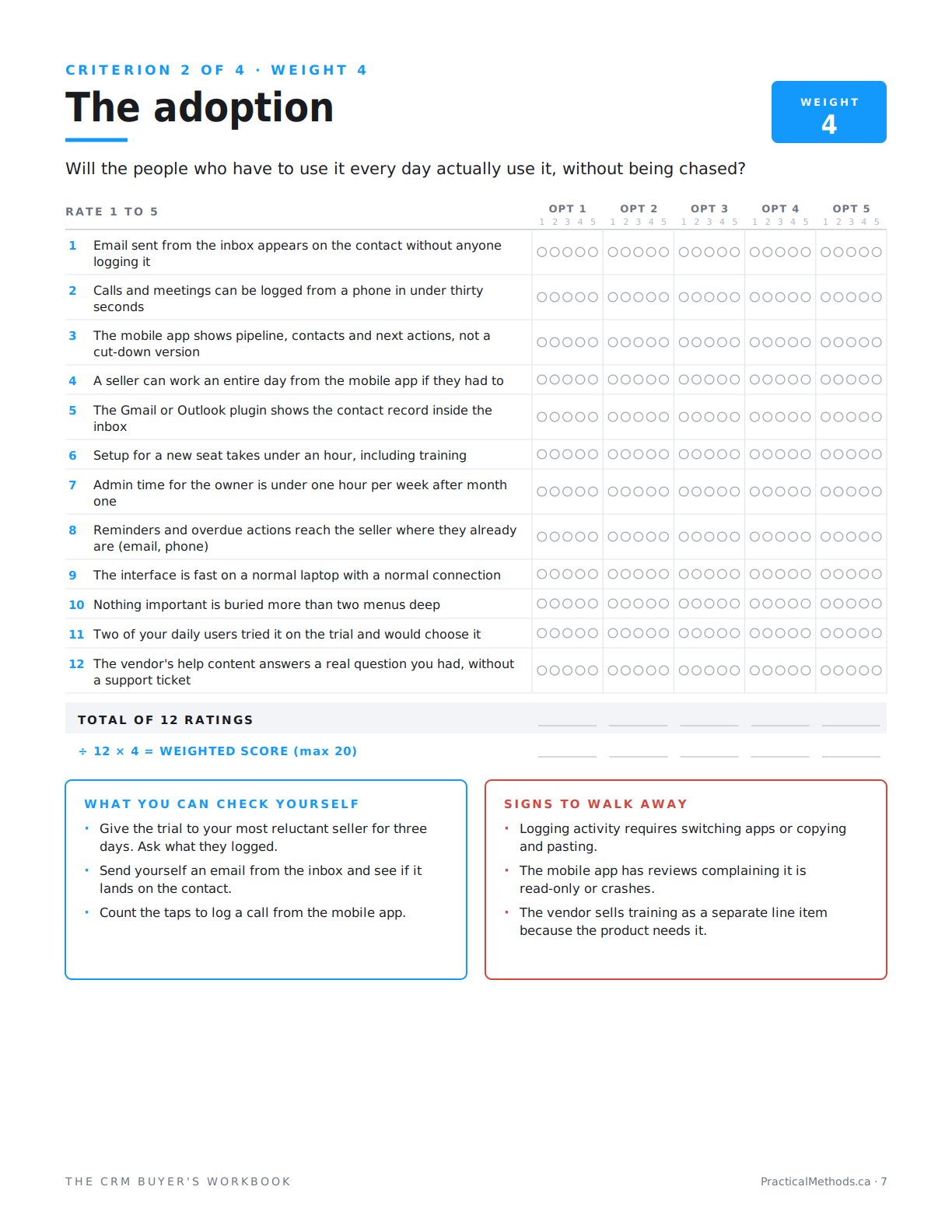
The reluctant seller test
Every team has one seller who thinks the CRM is an insult. Give that person the trial for three days. Do not coach them. At the end, open their activity log and count what they logged. That number is the adoption score. The enthusiast's opinion is worth nothing here; enthusiasts adopt anything.
If the reluctant seller logged more in one tool than another, that difference is the tiebreaker on the whole scorecard. It is written into the workbook that way on purpose.
The CRM Buyer's Playbook
The workbook, the Excel scorecard, the session deck and the facilitator's guide. Run it with your team in ninety minutes.
Get the Playbook · $49Why the mobile app is not a footnote
Sellers are on their phones after meetings, in parking lots, between calls. If the mobile app cannot log a call, add a note and set the next action, the call gets logged later, which means never. Count the taps to log a call from the app. Above five, it will not happen consistently.
The training tell
Some vendors sell training as a separate line item. Ask why. A tool for a team of twelve should be learnable from the help content in an hour. If the product needs a paid course, the product is telling you something about month four.
What adoption cannot tell you
A tool everyone happily logs into can still be the wrong tool. It might not do the three jobs, which is the job criterion. It might trap your data, which is the exit criterion. Adoption is weighted 4 because a CRM nobody uses is a spreadsheet with a monthly fee, but it is not the whole card.
Four things that predict month four
Automatic email logging is the first. A CRM that logs sent and received email without a manual step has the activity history whether or not anyone tries. One that needs a BCC address or a button has the history of whoever remembered. Test it by sending yourself an email from the inbox and looking for it on the contact record.
The second is the inbox plugin. Sellers live in email. A plugin that shows the contact record beside the message means the CRM is where they already are. Without it, the CRM is a second place, and second places get visited on Fridays.
The third is the reminder path. An overdue next action that sits in a dashboard is invisible. One that arrives by email or notification is a nudge. Ask where the reminder shows up, then ask whether the seller will be looking there.
The fourth is admin time. If the owner spends two hours a week fixing duplicates, adjusting permissions and chasing missing fields, the owner stops, and the data quality follows. Under an hour after month one, or the tool is generating work.
How to run this in the room
Adoption is the criterion where the room is most likely to split, because the enthusiast and the reluctant seller have opposite experiences of the same trial. Let them both speak. Then rate the reluctant seller's experience, because the team will behave like the reluctant seller, not like the enthusiast.
If the trials have not run yet, rate provisionally and mark the row. The reluctant seller's three days are an action item with a name and a date, and the final adoption score waits for it. The Excel scorecard will show a rank either way; the provisional one is not the decision.
One more thing to write down before the room moves on: the name of the seller who will run the three-day trial, and the date the log gets opened. Adoption is the criterion most often left provisional forever, because the trial is a favour asked of a busy person. Put a date on it. A tool that scored a provisional 4 on adoption and a real 2 is a tool the room bought on hope, and the 90-day review will say so.
Signs to walk away
- Logging activity requires switching apps or copying and pasting.
- The mobile app has reviews complaining it is read-only or crashes.
- The vendor sells training as a separate line item because the product needs it.
What to check yourself
- Give the trial to your most reluctant seller for three days. Ask what they logged.
- Send yourself an email from the inbox and see if it lands on the contact.
- Count the taps to log a call from the mobile app.
The series
- How to choose a CRM for a small business: narrow first
- The job: a CRM requirements checklist that ignores the feature page
- The adoption: why sales teams stop using the CRM
- The exit: what it costs to leave a CRM, checked before you sign
- The deal: the hidden costs in CRM pricing, and what to get in writing
Frequently asked questions
Why do sales teams stop using the CRM?
Because logging takes effort and nobody is chasing it after the first quarter. If logging a call is harder than not logging it, it stops.
Who should test the trial?
Your most reluctant seller, for three days, uncoached. Count what they logged. Enthusiasts adopt anything, so their opinion does not measure adoption.
How many taps to log a call is too many?
More than five from the mobile app. Above that, calls get logged later, which usually means not at all.
Should email be logged automatically?
Yes. If sending an email from the inbox does not land on the contact record without a manual step, the activity history will be incomplete within a month.
What is a reasonable admin time?
Under one hour a week for the owner or admin after the first month. Above that, the tool is generating work rather than removing it.
Is paid training a bad sign?
For a team under fifty, yes. A tool that needs a paid course to adopt is telling you how month four will go.
How is adoption weighted?
Four out of five. Average the twelve ratings and multiply by four. Maximum 20.
What if the enthusiast loves it and the reluctant seller hates it?
Score the reluctant seller's experience. That is the one that predicts the team.
The list is not the decision. It is how you find the one or two things that are.

