
Choosing Payroll Software
The deal: what payroll software actually costs at your size, next year, and on the way out
Quick answer: payroll software pricing is usually a base fee plus a per-employee fee per month, but the number that matters is the all-in annual cost at your headcount and at your 18-month headcount, with year-end, implementation, off-cycle runs, contractor seats and float fees included. The deal criterion, weight 3 of 5, scores ten questions on exactly that, and is weighted lowest because a cheap platform that fails the pay run is not cheap.
Three out of five.
Why the deal is weighted 3
Price is the criterion buyers score first and the method scores last. The deal is weighted 3 of 5 because the ceiling gate already removed anything unaffordable. What is left is a comparison among options you can pay for, and among those, a platform that fails the pay run is not cheap at any price.
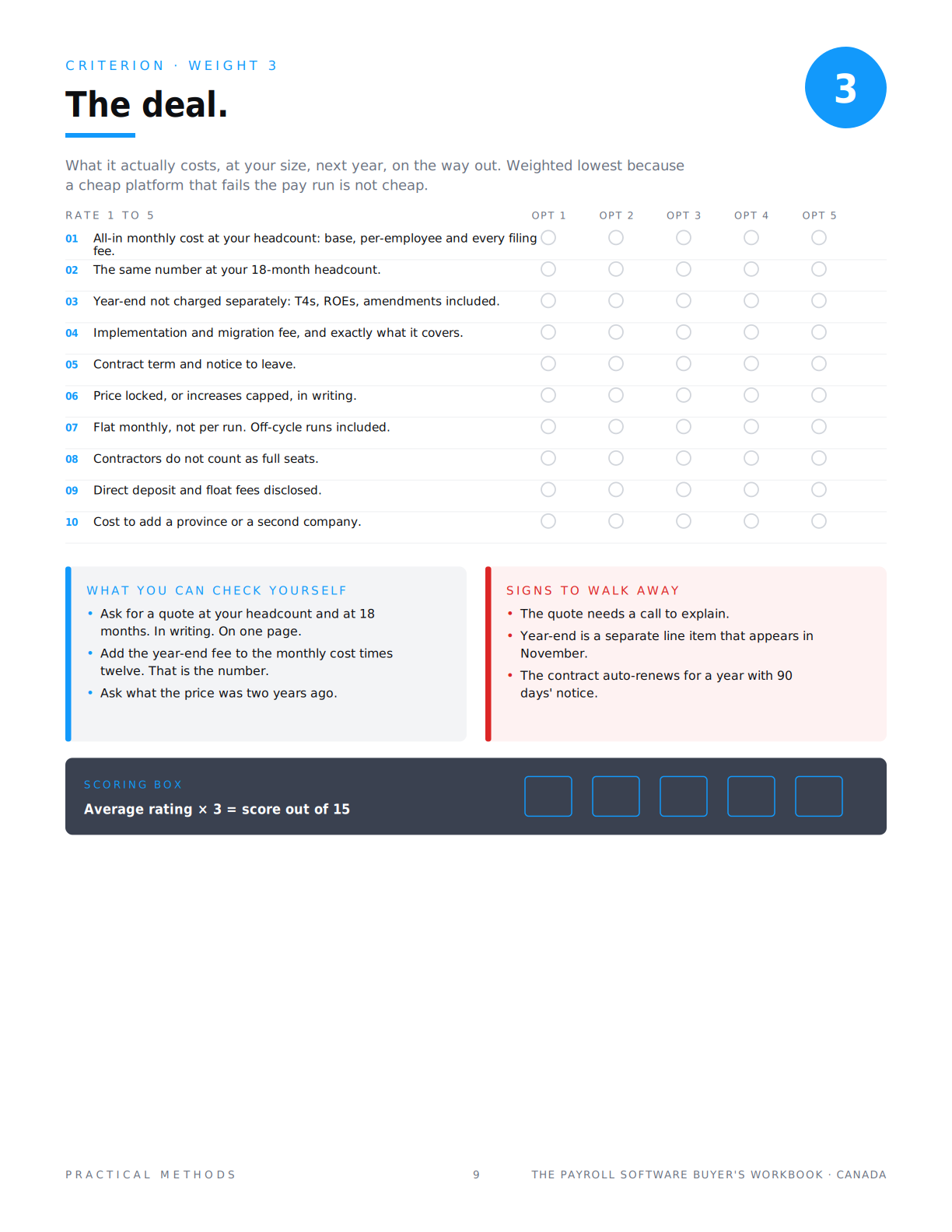
Rate ten questions 1 to 5, average, multiply by three. Maximum 15. The tiebreaker at the end of the scorecard is where price usually gets its real say, between two options within five points of each other.
How payroll software is priced
Most platforms charge a monthly base fee plus a per-employee fee. Some charge per pay run instead, which punishes weekly payrolls. Some charge for contractors as full seats; some charge for year-end slips separately; some charge for off-cycle runs, for adding a province or state, for direct deposit, or for the float between when they debit you and when they pay staff.
None of this is hidden exactly. It is spread across a pricing page, a terms page and a sales call, and it is rarely on one line. The deal criterion puts it on one line.
The number: monthly times twelve, plus year-end
Ask each vendor for a written quote at your current headcount and at your 18-month headcount, on one page, with every fee named. Then do one calculation: monthly cost times twelve, plus the year-end fee, plus implementation divided by three years. That is the number you compare, and it is the number the ceiling gate checks.
A quote that needs a call to explain is a 2. A quote that changes between the demo and the contract is a 1.
SIGNS TO WALK AWAY
- The quote needs a call to explain.
- Year-end is a separate line item that appears in November.
- The contract auto-renews for a year with 90 days' notice.
WHAT TO CHECK YOURSELF
- Ask for a quote at your headcount and at 18 months. In writing. On one page.
- Add the year-end fee to the monthly cost times twelve. That is the number.
- Ask what the price was two years ago.
The ten questions
All-in monthly cost at your headcount: base, per-employee and every filing fee. The same number at your 18-month headcount. Year-end not charged separately, meaning T4s, ROEs and amendments, or W-2s, 1099s and corrections, included. Implementation and migration fee and exactly what it covers. Contract term and notice to leave. Price locked, or increases capped, in writing. Flat monthly rather than per run, with off-cycle runs included. Contractors not counted as full seats. Direct deposit, ACH and float fees disclosed. Cost to add a province or state, or a second company.
Canada and USA: where the pricing differs
The ten questions are the same in both editions. Two things differ in practice. In Canada, watch for Quebec: some platforms price Quebec payroll as a separate add-on because of the second set of remittances and slips, and it appears on the quote only if you ask. In the USA, watch for per-state charges: a platform that includes state filings in one state may charge for each additional state registration, and local taxes are sometimes a further line.
Currency is the other. Several platforms sold in Canada quote in US dollars on the pricing page and bill in Canadian dollars at a rate they set. Ask which currency the contract is in and write the annual number in the currency you pay it in.
The three questions people skip
Price lock. Ask what the price was two years ago. A vendor that raised prices 30% in two years and will not cap the next increase is scoring a 2 on question six, whatever the current number.
Contract term and notice. A contract that auto-renews for a year with 90 days' notice is a trap you only discover in month ten. Read the term before the price.
Float. Some platforms debit your account days before payday and hold the funds. For a small business that is a cash-flow cost that never appears on a pricing page.
A 5 and a 2
A 5: one-page quote at both headcounts, year-end included, flat monthly, contractors at a reduced rate, price increases capped in writing, month-to-month or annual with 30 days' notice, no float.
A 2: per-run pricing, year-end 'depends on the number of slips', a 12-month auto-renew with 90 days' notice, and a price that went up twice since the last time you asked.
That is the fifth criterion. The scorecard adds the four scores for a total out of 80, marks any gate fail as OUT, and ranks what is left. Then the tiebreaker: when the top two are within five points, the score did its job, and you name the one thing that was never on the list.
The series
- Part 1: How to choose payroll software before you sit through a single demo
- Part 2: The pay run: the sixteen questions that decide whether payroll software belongs on your list
- Part 3: The filings: what payroll software files for you, and who pays when it is late
- Part 4: The people: what your staff see every two weeks, and what the owner sees on the first
- Part 5: The deal: what payroll software actually costs at your size, next year, and on the way out (this article)
Frequently asked questions
How much does payroll software cost for a small business?
Usually a monthly base fee plus a per-employee fee, with year-end, implementation and add-ons on top. The useful number is annual all-in at your headcount and at 18 months. Get it in writing on one page and compare that, not the headline rate.
Is payroll software charged per employee or per pay run?
Both models exist. Per-employee per month is the more common and the more predictable. Per-run pricing costs more for weekly payrolls and for off-cycle runs. Question seven prefers flat monthly with off-cycle runs included.
Do payroll platforms charge extra for year-end?
Some do, per T4 or W-2, and some charge for amendments. It is often a line item that appears in November. Question three asks whether year-end is included; add it to the annual number either way.
What is a payroll implementation fee?
A one-time charge for setting up the account, migrating employee and year-to-date data, and sometimes for training. Ask exactly what it covers and what happens if the migration runs long. Spread it over three years when comparing annual cost.
Can payroll software raise prices mid-contract?
Depends on the contract. Question six asks whether the price is locked or increases are capped in writing. Ask what the price was two years ago to see the vendor's habit.
Do contractors count as employees in payroll software pricing?
Some platforms charge contractors as full seats; some charge a reduced rate; some include them. If you have several contractors, question eight can move the annual number materially.
What is float in payroll?
The gap between when the platform debits your account and when staff are paid. Some platforms hold funds for several days. It is a cash-flow cost that does not appear on the pricing page; question nine asks for it to be disclosed.
How do I score the deal criterion?
Rate the ten questions 1 to 5 per option, average, multiply by three. Maximum 15. The Excel scorecard in the playbook does the arithmetic and adds the deal to the other three criteria for a total out of 80.
The list is not the decision. It is how you find the one or two things that are.

