
Choosing Payroll Software
How to choose payroll software before you sit through a single demo
Quick answer: choose payroll software by writing an eight-line shape (headcount, mix, provinces or states, ceiling), running a gate 0 test to check you need software at all, picking a rung on the ladder (bookkeeper, accounting add-on, standalone platform, HR suite), then running every option through six pass-or-fail gates: ceiling, path, filings, sync, security and exit. Only what survives the gates gets scored.
Why the shortlist is the wrong place to start
Most payroll software decisions start with a shortlist. Someone searches, someone gets a recommendation from an accountant, someone remembers a name from a podcast ad. Four demos get booked. Each demo shows forty features. The buyer remembers the last dashboard best and buys that one.
Then it is March. A remittance went out late, or a state notice arrived, and nobody in the building can say whose job it was. The platform was never wrong. It was never right for this company either. Nobody checked.
This series is the method that stops that. It runs in a fixed order: the shape, gate 0, the ladder, the gates, then scoring. Demos come after the gates, and only for what survived them. This article covers everything up to scoring. The next four cover the four criteria you score on.
The shape: eight lines before you look at anything
The shape is one page. It fixes what your company actually needs before a vendor tells you what it needs. Write it in a meeting with the person who signs, the person who will run payroll, and whoever does the books.
Headcount. Employees now and in 18 months. Software is bought for the company you are about to be.
The mix. How many salaried, hourly, commission, tipped, and contractors. This is the line that decides everything downstream. A company that is all salaried can use almost anything. A company with twelve hourly staff and seasonal layoffs cannot.
Provinces or states. Every one you pay someone in. One employee working from a cottage in a second province is a second province. In the USA, add local taxes: city, county, school district.
Pay frequency and operator. Weekly, biweekly or semi-monthly, and the name of the person who runs it. A name, not a department.
Accounting software. The system every pay run has to post to.
Deductions and accruals. Benefits, retirement match, vacation or PTO rules.
Annual ceiling, all-in. Base fee, per-employee fee, filing fees, year-end fees, implementation. If nobody knows last year's number, that is the first finding of the exercise.
Who signs. One name. The person who explains a late-filing penalty to the bank.
Gate 0: do you need payroll software at all this year?
Before the ladder, four questions. Fewer than five employees, all salaried? A bookkeeper or accountant already calculates and remits, or deposits and files, your payroll taxes? No hourly staff, no contractors, nobody in a second province or state? No hires planned in the next twelve months?
Four yes means stop. Keep the bookkeeper. Payroll software is bought to handle complexity, and you do not have any yet. Revisit at the first hourly hire, the first layoff, or the first out-of-province employee. Most small teams that run this gate honestly get at least one no, and it is usually the mix.
SIGNS TO WALK AWAY
- The vendor calculates remittances or deposits but you have to send them.
- The year-end fee is 'depends on the number of slips'.
- Mid-year switch with no YTD import and a shrug about year-end.
WHAT TO CHECK YOURSELF
- Write the eight shape lines before you book anything. Time it. Under twenty minutes means someone dodged the ceiling.
- Ask each vendor the three filings checks by email. A vendor that takes a week to answer has answered.
- Count the options marked OUT. Zero means run the gates again.
The ladder: pick the rung before the product
Payroll software is four different categories that share a name. Comparing across them on price tells you nothing.
Rung 1: the bookkeeper runs it. You send hours, they calculate, remit and file. Cheapest until the first record of employment at 4 pm on a Friday.
Rung 2: an accounting software add-on. Payroll bolted onto the books you already keep. Fine for one province or state and a simple mix.
Rung 3: a standalone payroll platform. Built to file. Remittances, ROEs and T4s in Canada, or federal deposits, 941s and W-2s in the USA, go out on their own. This is where most teams over ten people land.
Rung 4: an HR suite with payroll, or in the USA a PEO. Onboarding, time off, benefits and payroll in one system. Pay for the suite only if you will use the suite.
Agree the rung as a group, in one sentence, before anyone names a product. It takes five minutes and saves the rest of the hour.
The gates: six pass-or-fail checks
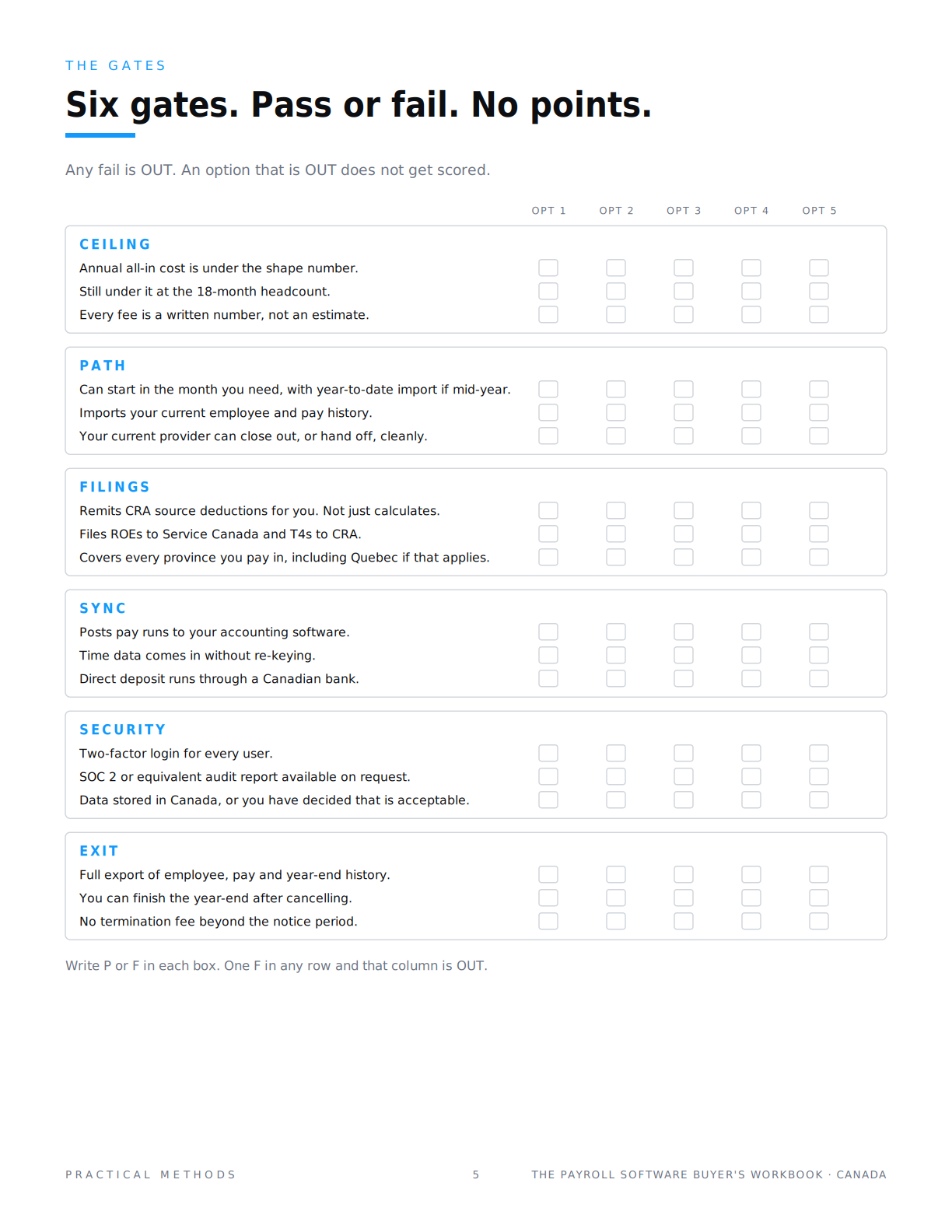
The gates are hard constraints, checked before any scoring. Each has three checks. An option that fails any one of them is out. It does not get scored, no matter how good the demo was. This is what stops the shiny option from winning on points.
Gate 1: the ceiling
Annual all-in cost under the shape number. Still under it at the 18-month headcount. Every fee is a written number, not an estimate. If a vendor cannot put the year-end fee in writing, that is a fail, not a question.
Gate 2: the path
Can start in the month or quarter you need, with year-to-date import if mid-year. Imports your current employee and pay history. Your current provider can close out cleanly. A January start is easier everywhere; a mid-year switch needs YTD figures to come across or year-end will be wrong.
Gate 3: the filings
This is the gate people get wrong. It asks whether the platform sends the filings, not whether it calculates them. Calculating is a spreadsheet. In Canada: remits CRA source deductions, files ROEs to Service Canada and T4s, covers every province including Quebec if you pay anyone there. In the USA: deposits federal taxes and files 941 and 940, files W-2s and 1099-NEC, handles withholding and unemployment in every state plus local tax.
Gate 4: the sync
Posts pay runs to your accounting software. Time data comes in without re-keying. Direct deposit runs through a Canadian bank, or through ACH without a manual file upload.
Gate 5: security
Two-factor login for every user. SOC 2 or equivalent audit report on request. Data stored in Canada, or you have decided that is acceptable. In the USA, SSNs and bank data encrypted with an access log you can see.
Gate 6: the exit
Full export of employee, pay and year-end history. You can finish the year-end after cancelling. No termination fee beyond the notice period. Switching payroll is painful enough that the exit gate is where the second-best platform quietly wins.
What done looks like
Eight shape lines with a number or a name. A gate table with no blanks, or blanks that have become a list of vendor questions with an owner. At least one option marked OUT. If nothing failed a gate, either the shortlist was too short or the gates were run too kindly.
Now you have two or three options and a reason for each. Now, and only now, book the demos. The operator drives. And the next article is what you score first: the pay run.
The series
- Part 1: How to choose payroll software before you sit through a single demo (this article)
- Part 2: The pay run: the sixteen questions that decide whether payroll software belongs on your list
- Part 3: The filings: what payroll software files for you, and who pays when it is late
- Part 4: The people: what your staff see every two weeks, and what the owner sees on the first
- Part 5: The deal: what payroll software actually costs at your size, next year, and on the way out
Frequently asked questions
How many employees do you need before payroll software makes sense?
There is no headcount threshold. The trigger is complexity: the first hourly employee, the first contractor, the first person in a second province or state, or the first layoff. Gate 0 in the workbook asks four questions; if all four are yes, keep the bookkeeper this year.
Should a small business use the payroll add-on in its accounting software?
Often, yes, if you pay in one province or state, the mix is simple, and the add-on files for you rather than just calculating. That is rung 2 on the ladder. Run it through the same six gates as anything else; the filings gate is where add-ons most often fail.
What is the difference between payroll software that calculates and payroll software that files?
Calculating means the software works out the deductions and hands you a number. Filing means it sends the remittance or deposit and the returns to the CRA, IRS, Service Canada or the state, on the schedule, without you. The filings gate requires filing. Calculating alone is a spreadsheet.
Is it better to switch payroll software in January?
Yes, where you can. A January start means no year-to-date figures need to come across and year-end sits with one provider. A mid-year switch is workable only if the new platform imports YTD figures and the old one can close out; that is the path gate.
What should a small business ask a payroll vendor before a demo?
The three filings checks, the all-in annual cost at current and 18-month headcount, the exit terms, and who pays the penalty if a filing is late. All by email, before the demo, so the demo is spent on the pay run rather than on features.
Does the method work for both Canada and the USA?
Yes. The shape, gate 0, ladder, gates and criteria are the same. The compliance layer differs: CRA remittances, ROEs and T4s in Canada; federal deposits, 941s, W-2s, state withholding and unemployment in the USA. The playbook ships both editions.
What is a PEO and is it payroll software?
A professional employer organization co-employs your staff and runs payroll, benefits and compliance under its own registrations. It is rung 4 on the ladder in the USA. It is not software you operate; it is a service you buy. Compare it against an HR suite, not against a rung 2 add-on.
How long should choosing payroll software take?
One hour for the shape, gate 0, ladder and gates as a group. Then two or three demos for survivors, then scoring alone in the Excel, then a thirty-minute follow-up. Two to three weeks end to end, most of it waiting on vendor answers.
The list is not the decision. It is how you find the one or two things that are.

