
Choosing Payroll Software
The pay run: the sixteen questions that decide whether payroll software belongs on your list
Quick answer: the pay run is the heaviest criterion at weight 5 out of 5 because a platform that cannot run your actual mix correctly, without a workaround, is not a payroll platform for you whatever else it does. Score it on sixteen questions: pay types, overtime and stat holiday rules by province or state, vacation and sick accruals, contractors in the same run, multi-region runs, taxable benefits, time import, direct deposit lead time, run time under thirty minutes, corrections without a phone call, garnishments, retirement deductions, accounting sync and mobile approval.
Five out of five.
Why the pay run is weighted 5
Every criterion in this method has a weight from 3 to 5. The weight-5 criterion is the one that decides whether an option belongs on the list at all. For payroll software, that is the pay run: does it run your mix, correctly, every two weeks, without a workaround.
Workaround is the key word. Almost every platform can run a salaried employee in one province. The differences show up in the second sentence of your shape: hourly staff, overtime rules that vary by province or state, statutory holiday pay, tipped wages, contractors, taxable benefits. A platform that needs a manual adjustment every run for any of those is not saving you time. It is moving the risk from the vendor to your operator.
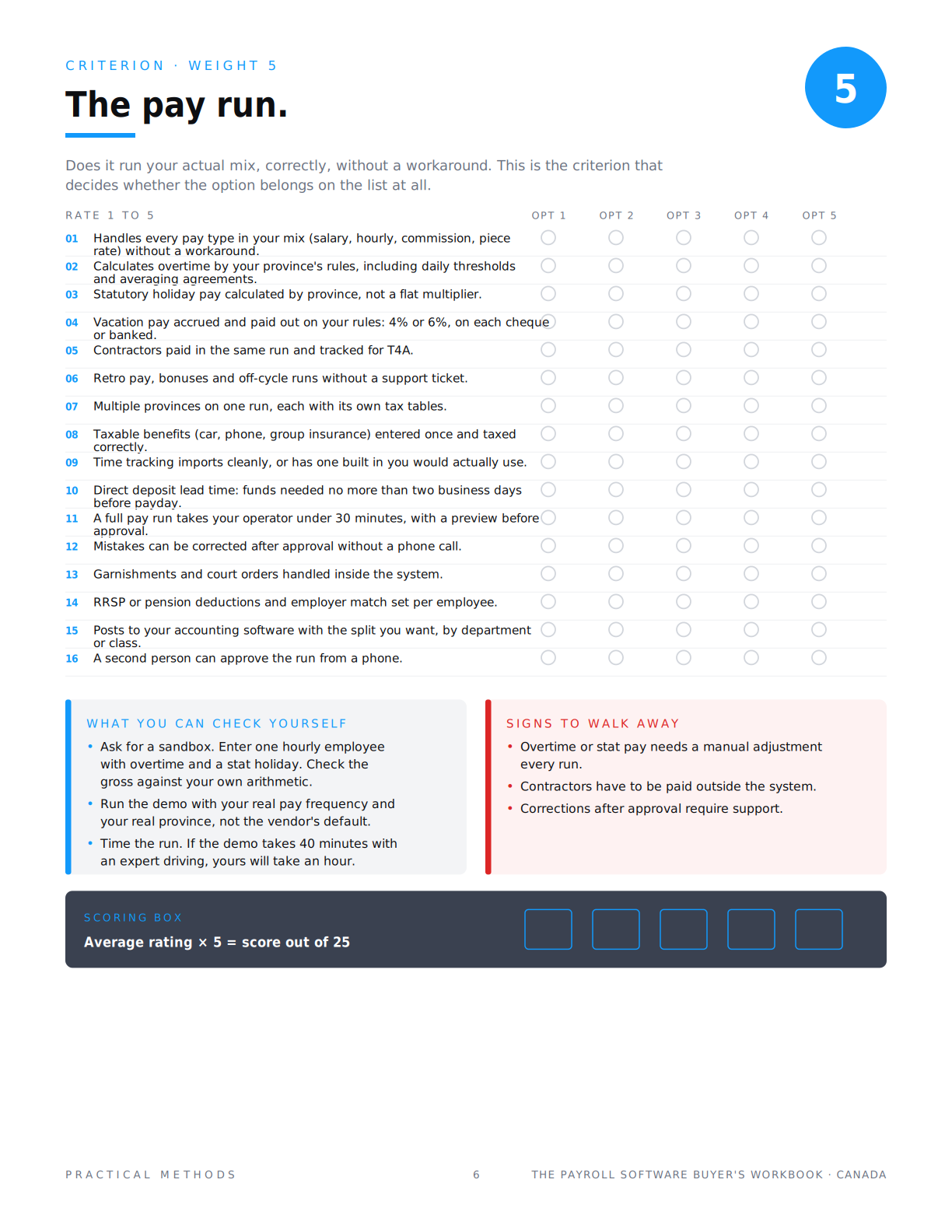
Rate each of the sixteen questions below from 1 to 5 for every option that survived the gates. Average the ratings and multiply by five. That is the pay run score, out of 25.
The questions, in three groups
The sixteen questions fall into three groups: does it handle the mix, does it handle the region, and does it handle the operator.
The mix
Every pay type in your mix without a workaround: salary, hourly, commission, piece rate, and in the USA tipped wages with tip credit. Overtime by your province's or state's rules, including daily thresholds and averaging agreements in Canada and daily overtime in states that have it. Statutory holiday pay by province, or holiday pay by your policy, not a flat multiplier. Vacation pay at 4% or 6% on each cheque or banked, or PTO and state-mandated sick leave accrued by state. Contractors paid in the same run and tracked for T4A or 1099-NEC. Retro pay, bonuses and off-cycle runs without a support ticket. Taxable benefits such as a car, phone or group insurance entered once and taxed correctly. Garnishments and court orders handled inside the system, with the remittance.
This group is where demos go wrong. The vendor runs a clean salaried example and the room nods. Bring your own example: one hourly employee, one week with overtime and a stat holiday, and check the gross against your own arithmetic.
The region
Multiple provinces or states on one run, each with its own tax tables, withholding and unemployment. Direct deposit lead time: funds needed no more than two business days before payday. RRSP, pension or 401(k) deductions and employer match set per employee, with pre-tax and Roth in the USA.
If you pay in one province or state today and might add a second in 18 months, score the second as if it were real. The shape said 18 months. Hold to it.
The operator
A full pay run takes your operator under thirty minutes, with a preview before approval. Mistakes can be corrected after approval without a phone call. Time tracking imports cleanly, or the built-in one is something staff would actually use. Posts to your accounting software with the split you want, by department or class. A second person can approve the run from a phone.
The operator is the person named in the shape, not the person in the demo. If the demo takes forty minutes with the vendor's expert driving, yours will take an hour.
How to score it without a demo
Three of the sixteen questions can be scored from the vendor's help documentation before you talk to anyone: overtime rules by region, correction after approval, and direct deposit lead time. Read the help centre. If the answer to 'can I correct a pay run after approving it' is a support article that begins 'contact us', score it 2.
The rest need a sandbox. Ask for one. A vendor that will not give a sandbox to a company with twelve employees is telling you something about the support you will get with twelve employees.
SIGNS TO WALK AWAY
- Overtime or stat pay needs a manual adjustment every run.
- Contractors have to be paid outside the system.
- Corrections after approval require support.
WHAT TO CHECK YOURSELF
- Ask for a sandbox. Enter one hourly employee with overtime and a stat holiday. Check the gross against your own arithmetic.
- Run the demo with your real pay frequency and your real province or state, not the vendor's default.
- Time the run. Forty minutes with an expert driving means an hour for you.
What a 5 looks like and what a 2 looks like
A 5 on the pay run: you entered your real mix in a sandbox, ran one full period with an overtime week and a stat holiday, the gross matched your arithmetic, the run took under twenty minutes, and you corrected a deliberate mistake yourself afterwards.
A 2: the demo was clean, you never saw your own mix, and the answer to contractors was 'most people pay those separately'.
The next article covers what you score second: the filings, and who pays when one is late.
The series
- Part 1: How to choose payroll software before you sit through a single demo
- Part 2: The pay run: the sixteen questions that decide whether payroll software belongs on your list (this article)
- Part 3: The filings: what payroll software files for you, and who pays when it is late
- Part 4: The people: what your staff see every two weeks, and what the owner sees on the first
- Part 5: The deal: what payroll software actually costs at your size, next year, and on the way out
Frequently asked questions
What is the most important feature in payroll software?
For any company with hourly staff, contractors or more than one province or state, it is running that mix correctly without a workaround. That is the pay run criterion, weighted 5 of 5. Dashboards, integrations and price matter less than a gross that matches your arithmetic every period.
Can payroll software handle overtime rules that differ by province or state?
The good ones do, including daily overtime thresholds, averaging agreements in Canada and daily overtime in states like California. It is question two of sixteen. Score it by entering one overtime week in a sandbox and checking the result yourself.
Should contractors be paid through payroll software?
If you pay contractors regularly, paying them in the same run and having the platform track T4A or 1099-NEC totals removes a year-end scramble. A platform that says most people pay contractors separately is answering the question. Score it accordingly.
How long should a payroll run take?
Under thirty minutes for the operator, including preview and approval, for a company under fifty employees. That is question eleven. Time the demo and assume your run will take longer than the vendor's.
Can you correct a payroll run after it has been approved?
It depends on the platform, and it is one of the questions that separates options fastest. Some allow the operator to reverse or adjust a run themselves; others require a support ticket. Check the help centre before the demo.
Does payroll software handle statutory holiday pay?
Most calculate it, but not all calculate it by province, and a flat 1.5 multiplier is wrong in several provinces. Question three asks whether it uses provincial rules. In the USA, holiday pay follows your policy rather than statute, so the question becomes whether your policy can be configured.
What is direct deposit lead time?
The number of business days before payday that funds must leave your account. Two days is normal; four is a cash-flow problem for a small business. It is question ten and it is rarely in the sales deck.
How do I score the pay run criterion?
Rate each of the sixteen questions from 1 to 5 per option, average them, and multiply by the weight of 5. Maximum 25. The Excel scorecard in the playbook does the arithmetic. Leave a question blank if it does not apply to your mix.
The list is not the decision. It is how you find the one or two things that are.

